


Menu
By theme
By theme





{{ variable.name }} : {{ variable.values[selectedVariantsIndex[variable_index]].name }}
Quantity:
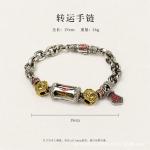
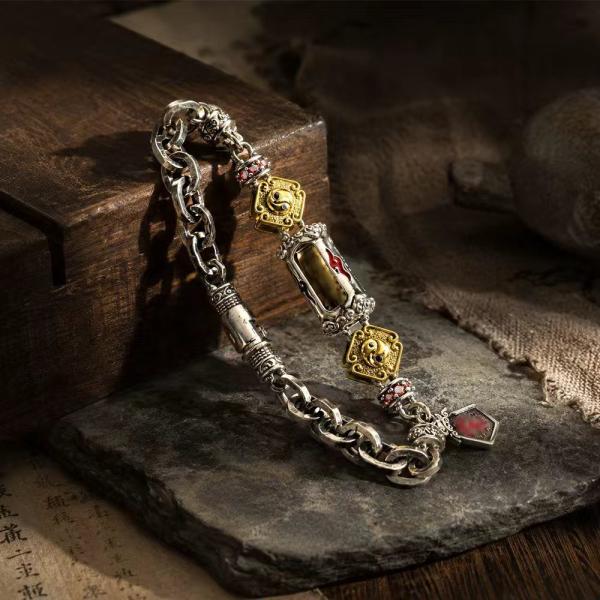
The bracelet is a fixed length, adjusted by an extension chain. The clasp is a small lobster claw, and once closed there is some slack that a finger can pull. The links are soldered shut and will not stretch, which is less trouble than a chain of interlocking rings. The solder joints are small and disappear after polishing; only at close range is there a faint hollow. A small copper bead hangs at the end of the extension and taps once as you walk, very lightly.
The body of the chain is fine, link joined to link, each carrying a section of engraved line. The pattern is not characters but continuous curves, one turning into the next, like cloud and like water. Laid out flat, the curves on the whole chain join into one line, and the breaks fall exactly between links. The links are stamped, with a fine ridge at the edge that you can feel as a step. The clasp is small, so it does not press the wrist under a long sleeve.
This script is called cloud seal, and Daoism holds it to be the earliest form of writing, said to be patterns formed by cloud vapour in the sky. In surviving examples it appears mostly in manuscript scriptures and talismans, the strokes coiled so that no character can be made out; what matters is that the pulse of the line never breaks. Cut into copper it has to be flattened, the coils simplified to a single line. Without simplification it cannot be cast, and simplified too far it becomes mere ornament. Cloud-seal strokes are rounded, the entry hidden and the close drawn back, and the knife cannot stop.
The bracelet is worn with the pattern facing out. Some like to stack it with a watch, but copper against steel abrades both and in time both are scratched. If you stack, put a layer between, or wear it on the other wrist. A dark sleeve covers half the chain, and the section left showing is exactly where the pattern is densest, which looks better. On a thin wrist the chain turns inward and the pattern faces the skin, visible only to the wearer.
Cleaning a copper chain is more trouble than a plaque, because there are more crevices. Warm water with a drop of dish soap, swirl the chain for thirty seconds, rinse and dry on a cool hairdryer setting. A towel is the wrong tool, since the fibres catch on the links. If the chain has gone very dark, pinch a silver cloth along it section by section rather than pulling the whole length at once, which can pull a solder joint open. If you wash it and do not wear it, let it dry completely before storing, because moisture sealed in a bag is what grows green spots.