


Menu
By theme
By theme




{{ variable.name }} : {{ variable.values[selectedVariantsIndex[variable_index]].name }}
Quantity:
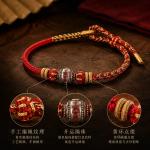
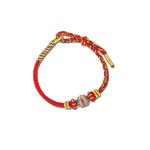
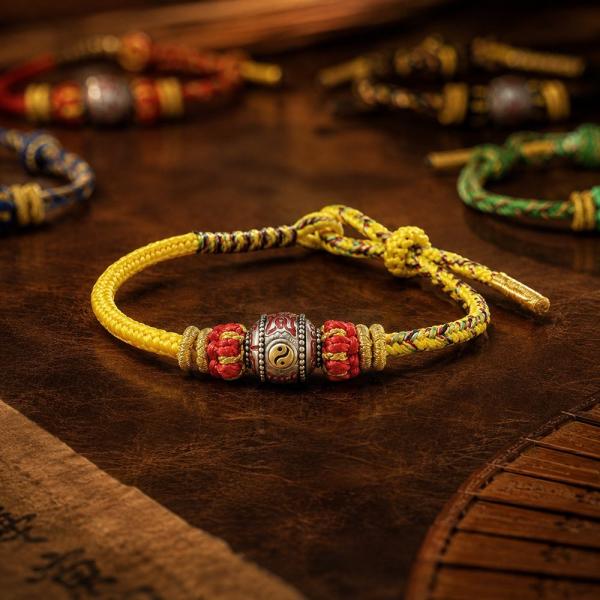
The cord is braided, four strands crossing back and forth into a flat band, with a copper spacer caught in it at intervals. Each spacer carries a talisman, small, the strokes crowded together, so that you have to look closely. A short length is left at the tail and closed with a knot, the end burned so that it will not unravel. The braid is tight, so it will not stretch with wear and does not fuzz easily. Cord thickness is matched to the spacers: too thin and the beads turn on the cord.
On this cord the spacers mark sections. A braid with no intervals looks monotonous after a while, and a few copper beads give it a rhythm. The copper also pins the strands, so the cord does not loosen. Mixing beads into a braid is common in Tibetan-style cords and among curio collectors; it is not new, but it works. The bore of a spacer is a little wider than the cord, so the cord can slide inside and does not bind when the fit is drawn up.
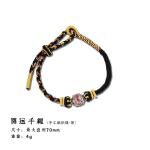
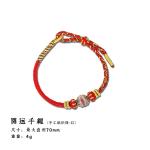
Six colours, falling into two groups by talisman. The fortune charm comes in yellow, black, green and blue cord, the Wenchang charm in red and white. The talismans differ and the cord colour follows: yellow for fortune and red for Wenchang, which is the folk convention. Choose by use and by clothing: black goes with everything, red is conspicuous, and white is choosy about skin tone. Of the six, the green leans ink and the blue leans grey, neither of them bright, so they do not jump against clothes. The talisman is cut round the barrel of the bead, all the way around, with a hairline gap left at the seam.
The size is given as adjustable at the opening, set by the sliding knot at the tail. Slip it on and draw both tail cords until it sits against the wrist; do not pull it tight, since a braid has no stretch and will bind. The knot loosens with use, so tie it again, trimming the frayed ends first. Tie the sliding knot twice: the first pass sets the shape and the second finishes it, while one pass alone slips.
A braid fears water and sweat. The salt in sweat dries into a white bloom on the cord and the colour goes grey. Push it up the arm when washing your hands and keep the cord out of water as far as possible. The copper spacers can be wiped with a cloth; the braid can only be pressed with a damp cloth, because rubbing raises fuzz. If the cord breaks, do not splice it yourself, since a braid will not hide a joint. Trim fuzz with scissors rather than pulling it, which only draws out longer fibres.