


Menu
By theme
By theme

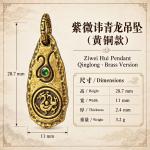
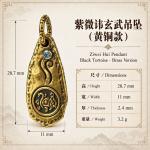
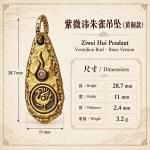
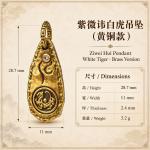
{{ variable.name }} : {{ variable.values[selectedVariantsIndex[variable_index]].name }}
Quantity:
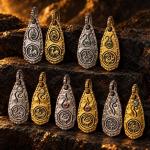
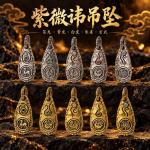
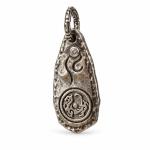
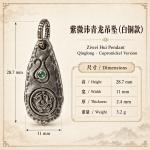
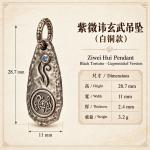
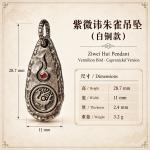
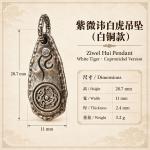
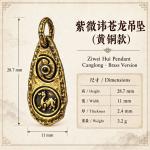
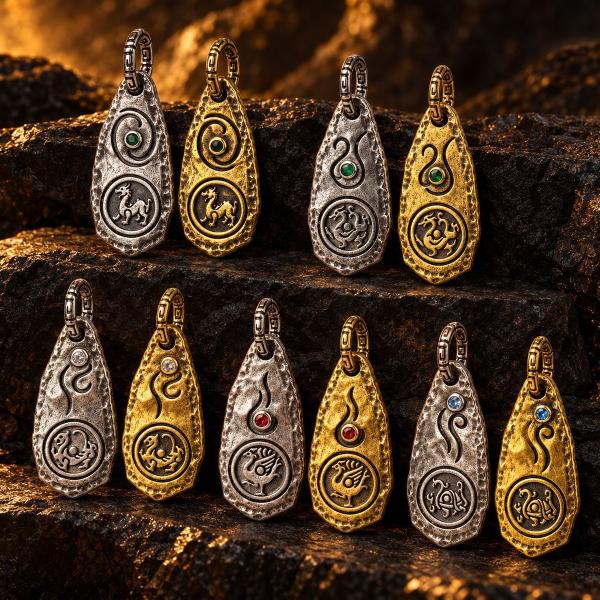
Four animals on four plaques, which also make a set. The Azure Dragon coils, the White Tiger crouches, the Vermilion Bird spreads its wings, and the Black Tortoise is a tortoise and snake wound together. Each composition differs: the dragon fills its plaque, the tiger leaves a margin, the bird’s tail feathers run to the lower edge, and the tortoise is the heaviest and sits at the centre. The backs are flat, so they do not dig when worn against the body or catch an undershirt. The plaques are round, with a plain ridge at the edge holding the animal inside.
The four images are old. On the lacquered box lid from the tomb of Marquis Yi of Zeng, from the Warring States period, the twenty-eight mansions are painted together with dragon and tiger, among the earliest surviving examples. By the Han the four were fixed, appearing everywhere on roof tiles, mirrors and pictorial bricks, with the directions settled: Azure Dragon east, White Tiger west, Vermilion Bird south, Black Tortoise north. Once they entered the mirror, the layout of the back was fixed too, a knob at the centre and one animal to each side. On Han bricks the four are usually drawn with cloud vapour, the bodies moving through it.
The pairing of four directions with four colours belongs to the five-element system. The Azure Dragon is wood, colour blue-green, direction east; the White Tiger is metal, colour white, west; the Vermilion Bird is fire, colour red, south; the Black Tortoise is water, colour black, north. The colour options here include yellow and white, which do not always follow the five elements; some are only grounds, yellow behind blue-green or white behind black, chosen to show. The five elements with five colours is a complete system, and the centre belongs to earth, colour yellow, which is why yellow appears most often among the options.
Six options: Azure Dragon on yellow, Canglong on white, White Tiger on yellow, Black Tortoise on white, Black Tortoise on yellow, and Vermilion Bird on yellow. Canglong and Azure Dragon are two names for the same image, cang being deep blue-green; the colours differ while the mould is the same. Anyone assembling a set should note that there is no White Tiger on white, so to get four colours you have to pick, and if you cannot complete the set, wear one alone. The white Canglong leaves the dragon’s body the colour of the metal and draws the scales in dark line, so that the scales only show close up.
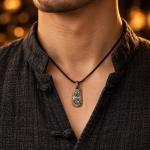
Four plaques worn together is heavy, so most people choose one. All the rims are chamfered, so a single plaque does not dig. Oxidation starts in the recesses, and the scales, feathers and shell plates are all recessed, so the pattern grows clearer as the colour settles. Brush along the pattern when cleaning rather than across it, because across flattens the highlights and blunts the scales. When storing all four, keep soft cloth between them, since copper against copper will knock little dents.