


Menu
By theme
By theme

{{ variable.name }} : {{ variable.values[selectedVariantsIndex[variable_index]].name }}
Quantity:
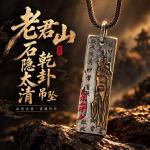
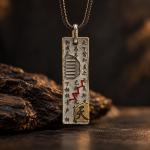
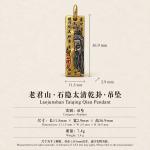
Laojun Mountain stands in Luanchuan, Henan. The Laojun temple on the summit is dedicated to Taishang Laojun; the mountain takes its name from the temple, and the temple takes its name from Laozi. Local tradition holds that after Laozi rode west through the Hangu Pass he withdrew here to lecture. That is a local legend, and the gazetteers do not agree on the details, but the mountain's bond with Daoism is real, the incense has never stopped, and several old sites connected with Laozi remain on its slopes. The relief on the plaque is largely the outline of the summit temple, and anyone who has climbed the mountain will match it at once.
The two characters taiqing name the Taiqing realm among the Three Pure Ones, the dwelling of Taishang Laojun. In a Daoist temple the hall of the Three Pure Ones places Yuanshi at the centre, Lingbao to the left and Dade to the right; Taiqing answers to Dade Tianzun, which is to say Laozi. Carving taiqing on this plaque binds the title to this mountain. These are not two characters chosen at random, and anyone who knows the material will see the source immediately. The names of the Three Pure Ones took shape in the late Northern and Southern Dynasties and flourished under the Tang, and the term taiqing settled about then as well.
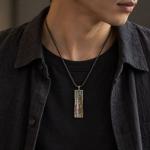
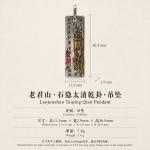
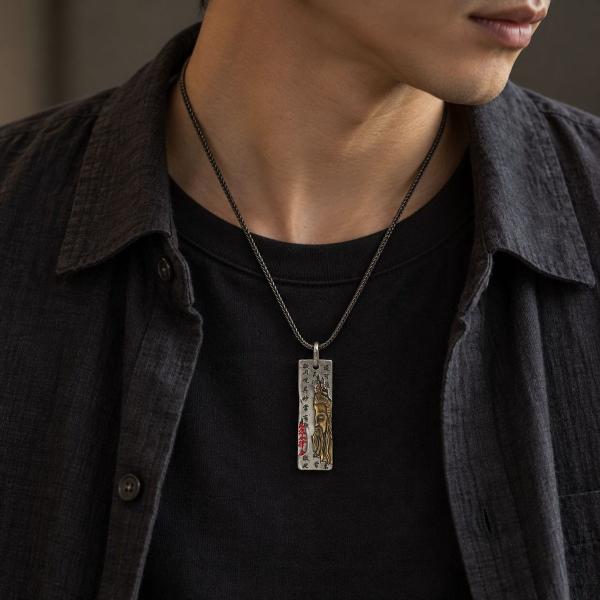
The format is a long plaque, a vertical strip, more formal than a round one and more demanding about what you wear with it. It is cast in white copper, the face given mainly to the mountain. A long plaque knocks softly against the chest as you breathe, sits above the stomach, and catches the edge of a desk when you sit down. Anyone who works at a desk should expect that, or simply shorten the chain. The thickness has to be even and the edges chamfered round so they do not scrape the hand; only then is the finishing up to standard.
The same design comes in white and yellow, each as a pendant or a necklace. White is the cool tone of white copper itself and reads clearly against dark clothing; yellow runs warm and sits better with warm-toned beads such as sandalwood or old amber. Decide by skin tone and by what hangs in your wardrobe; there is no need to agonize over which is the more respectable. The white one drifts toward grey with long wear, while the yellow fades first along the edges. You accept both temperaments or you choose the one you can live with.
Plaques carrying a mountain's name are most at risk of sliding into souvenir work: the mountain flattened to a silhouette, the characters badly spaced, the back left blank. The way to tell is the depth of the relief and the finish where it meets the ground. Deeper, with clean corners, means both the mould and the polishing were done with care. Wipe it with a soft cloth and keep gritty paste away. When dust gathers in the grooves of the relief, brush it out dry with a soft brush rather than picking at it with a needle. A cord suits a long plaque better than a chain; choose a flat knot or a lucky knot, not an elaborate braid.