


Menu
By theme
By theme

{{ variable.name }} : {{ variable.values[selectedVariantsIndex[variable_index]].name }}
Quantity:
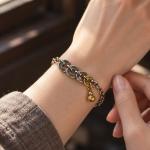
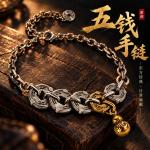
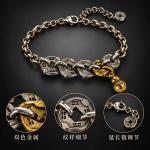
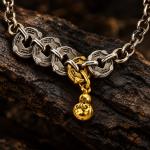
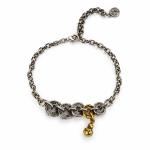
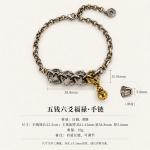
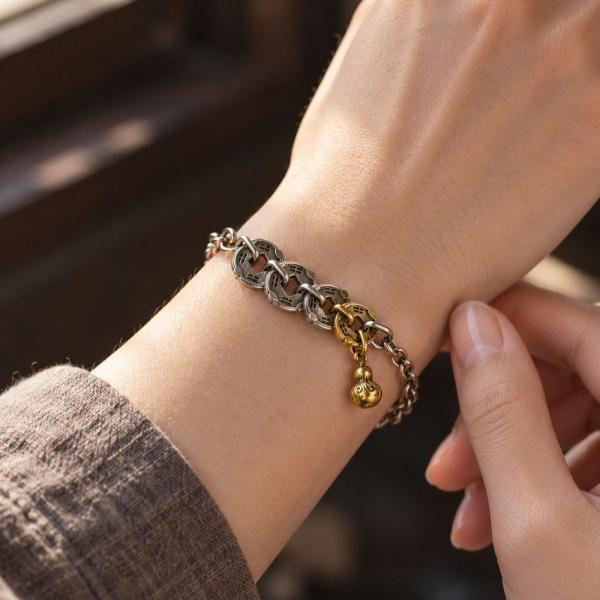
Six-line divination is the Zhou Yi method of building a hexagram: three coins, shaken six times, the lines laid from the first to the top to give one hexagram. Three coins, not five. The ruling and responding lines and the moving lines all come out of those six throws. The bracelet strings five coins, taking the shape of coinage rather than serving as a casting set, and that should be said plainly so nobody buys it expecting to throw a hexagram. The five need to be close in thickness so they do not fight each other on the cord and lie even when turned.
In divination the coin governs yin and yang: the inscribed face is yang, the reverse is yin, and three shaken together give old yang, old yin, young yang and young yin. The rules had a prototype by the Han and peaked under the Ming and Qing, and the stalls of street diviners still use these three coins today. Stringing five into a bracelet wears that set of symbols on the wrist, which is a matter of keeping the idea close. Casting asks for a quiet mind, and the old advice is to warm the coins in your hand before tossing them; that belongs to the practice, not to the bracelet.
The five-coin idea differs by region: some speak of the five emperor coins, some of the five elements and five directions, and some simply run down Shunzhi, Kangxi, Yongzheng, Qianlong and Jiaqing in order. This bracelet takes the ancient coin as its theme, with the legends artificially aged and a little casting flash left at the rim; it does not aim at new. People who like things clean may find it rough, while people who handle copper rather approve of the roughness. Ageing has a limit: overdone it becomes dirt, and legends gone fully black can no longer be read.
Worn against the skin, brass changes colour: bright at first, then darker, the recesses blackening first while the raised characters polish bright. The process cannot be hurried and cannot be stopped. It depends on your sweat, the weather and your clothing, and the same bracelet will go two different colours on two different people. For an even colour, wear it and wipe it often; to keep the old air, leave it mostly alone in a dry place. Elastic cord and plain cord each have their case: elastic goes on easily, plain cord looks better with time and is simple to replace when it breaks.
This bracelet suits a friend who likes the Zhou Yi and enjoys handling beads. For an elder, it is worth saying that it is a bracelet on an ancient-coin theme and not a ritual implement, so nobody mistakes it for something that tells fortunes. A short printed note on six-line casting in the box is worth more than a long spoken explanation, and it makes you look like you know the ground. Do not wear it next to a very bright watch; an old piece and a new one side by side make both look wrong.