


Menu
By theme
By theme





{{ variable.name }} : {{ variable.values[selectedVariantsIndex[variable_index]].name }}
Quantity:
The spacer is the supporting player in a strand. Its job is to separate the main beads and to set the rhythm of the whole. A strand without spacers has every bead pressed against the next and looks stifled; add spacers and the eye has somewhere to pause, and the length comes out right as well. Many people make them; few make them well. On old strands spacers were also graded by material, wood, southern red agate, turquoise, copper, laid out layer by layer. Their colour sets the key too: cool tones look clean, warm tones look old.
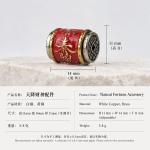
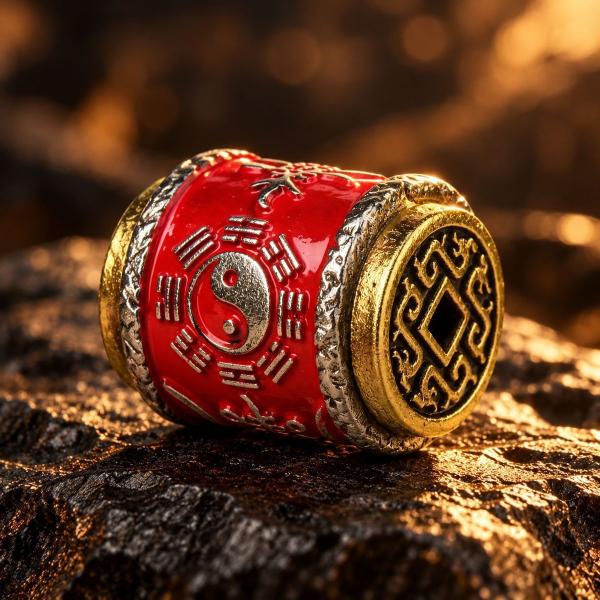
The barrel bead is a cylinder, flat at both ends and slightly swollen in the middle, like a small wooden bucket. Turning this form calls for the two end faces to be parallel and the hole to sit on the true axis; off a little and the whole strand hangs crooked. Turning a white copper barrel is harder than turning a round bead, since a sphere forgives and a barrel's edges cannot hide anything. Height and diameter need a proportion: too tall and it looks like a length of pipe, too flat and it becomes an abacus bead.
Taiji and bagua are the pattern here. The taiji diagram is one yin and one yang; the eight trigrams, qian, dui, li, zhen, xun, kan, gen and kun, spread out in a ring. This is the most basic symbol system in Daoism and the commonest ornament on old compasses, mirrors and roof tiles. Cut onto a small area like a barrel bead, the lines have to be reduced until only the idea is left. Each trigram is three lines, a solid stroke for yang and two short ones for yin, and the eight sets cannot fall out of order; get one line wrong and it is no longer that trigram. Taiji is about yin and yang holding each other, bagua about fixing the eight directions, and pressing both onto one bead means the pattern has to give way.
Used as a fitting, white and yellow can be mixed. On a strand of dark wood beads, add one white every two beads and the brightness lifts; a brass spacer sits better with old beads, the colour close and not competing. Buy by the hole size of your main beads: a spacer with a small hole will not go on, one with a large hole will rattle. The inside of the hole should be smooth, since a rough wall wears the cord, makes stringing a chore and breaks the cord sooner.
Small pieces like this give the game away in the details: whether the hole mouth is chamfered, whether the edges carry burrs, whether the surface has pinholes. Run a finger round the hole mouth when the piece arrives; if it scratches, there is no chamfer and the cord will wear through. People who string their own often make one mistake, buying spacers larger than the main beads, which turns the hierarchy upside down. The rule is that a spacer is no larger than the main bead, at most equal. Buy a couple extra so that the colour matches the batch.