


Menu
By theme
By theme

{{ variable.name }} : {{ variable.values[selectedVariantsIndex[variable_index]].name }}
Quantity:
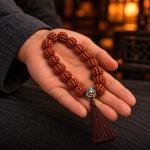
The three-hole bead is a joint in a mala. When a strand reaches the position of the Buddha head, the cord divides three ways: one run goes to the stupa piece, two take the disciple beads, and the bead with three holes is called the three-hole bead, or the Buddha head. It is a structural part and also the finish of the whole strand. Below it usually comes a stupa piece shaped like a small gourd, and only then the disciple beads; the closing of a mala happens entirely in this stretch.
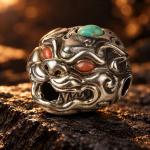
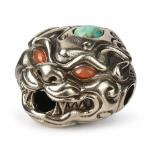
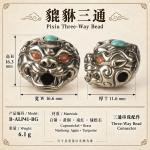
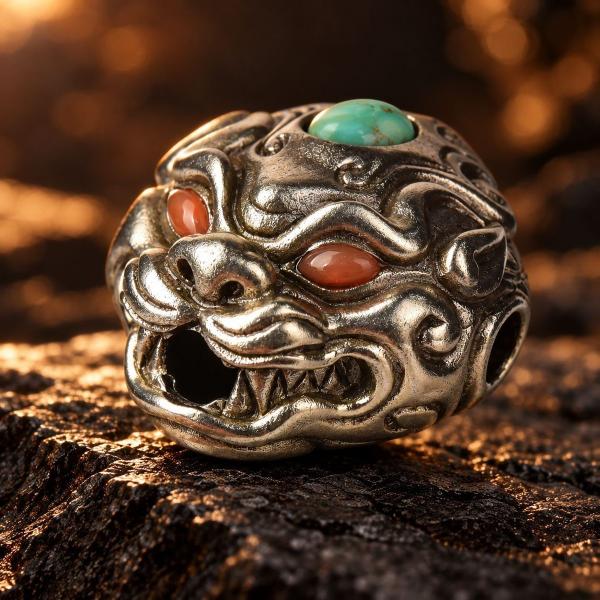
This one turns the three-hole bead into the head of a pixiu. In the old texts the pixiu first meant a fierce beast, listed alongside bears in the Shiji, and the Han also used the word for valiant troops. Only later did it settle into a folk auspicious beast, well established by the Ming and Qing, with the saying that it has a mouth and no anus, so it takes in and never lets out. That is folk legend, not a textual conclusion. Folk custom treats it as a wealth-drawing beast and often places it at a shop door or on a counter corner, in jade, copper or porcelain.
Making a beast head into a three-hole bead, the difficulty lies in the hole positions. The three holes have to meet the underside and the two sides at a workable angle: too wide and the cord knots, too narrow and the pendant hangs crooked. Casting in white copper forms them in one go, steadier than drilling afterwards, and the walls come out smooth. There is another point about the angle: the meeting point of the three holes should fall on the beast head's centre of gravity, or it will hang askew.
A pixiu is judged on three things: the eyes must have life, the teeth must show without being sharp, and the curve of the spine must run smoothly. The first two decide whether it is fierce, the last whether it reads as a beast at all. A badly made pixiu looks like a lump at a distance, and only up close do you find the features smeared together. The ears and horns are the thinnest points and the likeliest to run short of metal when the mould is pulled, so hold the piece to the light and check the outline for gaps.
As a fitting it works with dark wood beads or with bodhi root; keep the beast head facing outward, not toward yourself. The three-hole bead sits most steadily at the lower third of the strand: higher and it looks top-heavy, lower and it drags. White copper changes colour against the skin, the recesses of the head darkening first while the raised nose bridge and brow bone stay bright, so wear brings out the layers by itself. Wrap it in a soft cloth when it is not being worn, and do not drop it in a pocket with your keys; a dent cannot be put back. Copper fittings need no oil, since oil holds dust and the crevices only go blacker with wiping. A dry cloth and a dry brush are the safe way.