


Menu
By theme
By theme


{{ variable.name }} : {{ variable.values[selectedVariantsIndex[variable_index]].name }}
Quantity:
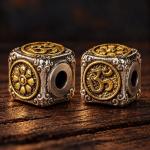
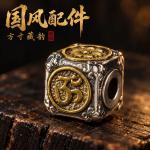
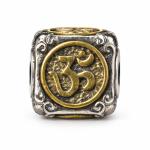
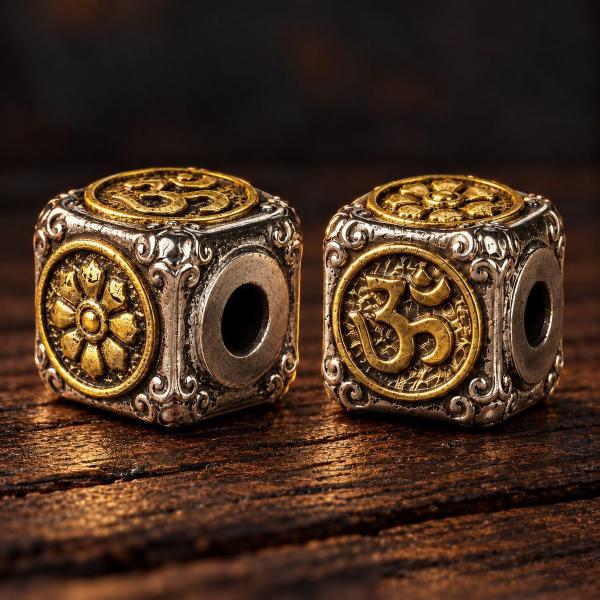
The six-syllable mantra is Avalokiteshvara's great mantra, om mani padme hum, the most widely known line in Tibetan lands. It is cut on prayer wheels, on agate beads, and it suits a square bead as well, since the six syllables spread out to fill one face exactly. In Tibet it is carved on stone and on mani piles, and the saying there is that each pass of the wind counts as one recitation. Translations of the meaning differ, so there is no need to force one; most people who recite it are not after the literal sense.
The mantra depends on how it is written. Sanskrit, Tibetan and Chinese characters are all in use. The Chinese form has many strokes and has to be crowded onto copper, and once the cuts blur it becomes a blot. The arrangement of the six depends on the mould: some run in a single line, some split into two, and the line spacing should be even. In Chinese the two characters ba and mi carry the densest strokes and blur most easily when cut, so they are usually set one size larger.
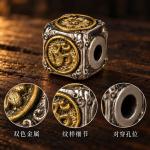
Auspicious clouds as a ground pattern are an old Central Plains habit. Cloud motifs existed by the Han, and by the Ming and Qing they had divided into ruyi clouds, round clouds and scattered clouds, valued for flow rather than realism. The mantra presses down on top, dense against sparse, and the surface does not go dull. The clouds have a rule of their own: they should come in groups, three or five together, and scattered at random they fall apart.
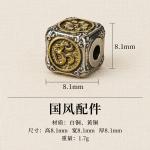
A square bead has more uses than a round one. It can be a spacer, a back pendant, or the main bead of a wrist strand; the flat faces turn outward and the pattern sits straight. With the hole centred it will not twist on the cord, which is better than a square bead pierced off centre. Side lengths should be close for a set, since a large one beside a small one shows the moment it turns. Count the pieces and compare the sizes when buying, which beats judging from a photograph. Only one face carries the mantra and the rest are left plain, so there is rhythm as it turns.
On a white copper square bead the four edges should be rounded over. Round them too much and it becomes a round bead; too little and it cuts the cord. Check the edge in the hand: a single line running unbroken from end to end means it was made true. Bodhi, coconut shell and southern red agate have all been tried with it, and the best match is a dark strand, where the white of the copper springs out. One in a strand is enough; more and it looks like a shelf. The six-syllable mantra is a Buddhist invocation, not a Daoist talisman, so do not string it with thunder orders and bagua, since anyone who knows will find it jarring.