


Menu
By theme
By theme




{{ variable.name }} : {{ variable.values[selectedVariantsIndex[variable_index]].name }}
Quantity:
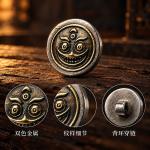
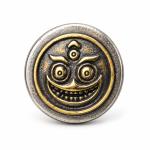
The smiling face has no source in traditional pattern. It is a thing of the last few decades. A round charm carrying a face with eyes curved in a smile holds no allusion and does something very direct: you look at it and something in you loosens. Everyone in this trade knows that the less a pattern refers to anything, the more it tests the hand, because there is no source to hide behind. The circle is the easiest format and the one that hides workmanship least, with its rim exposed all the way round, and most people touch the edge first.
The simpler the pattern, the harder it is to make. A smiling face is a few lines, and a small error in the curve turns the expression from happy to perfunctory. With small pieces like this you draw dozens on paper before the knife goes in and pick one that is neither slick nor silly. Half a millimetre off in the arc changes the curve of the eye, and there is no middle ground between a smile and no smile at all.
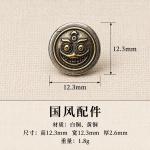
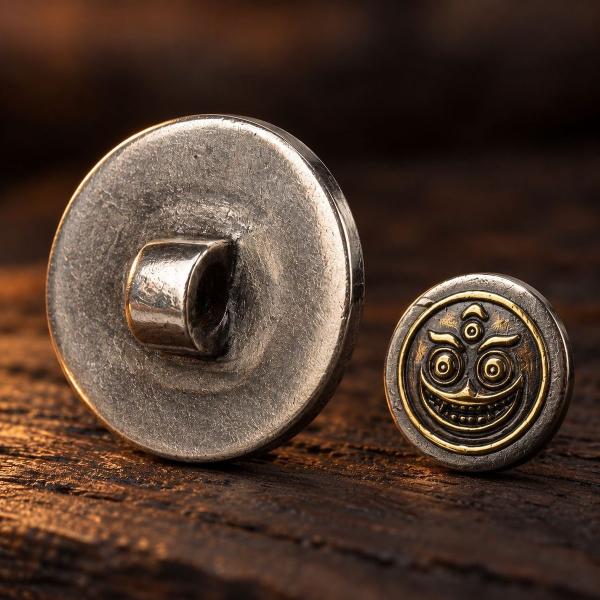
A round charm is freer in use than a pendant. It can be knotted on a cord for the neck, hung on a bag, put on a key ring, or sewn onto cloth. The back is usually left flat or given a small loop, and the direction of that loop decides whether it hangs straight. A loop at the top centre hangs true; off a little and the charm is forever crooked. For a knotted cord, dark grey or ink green wears better than a true red. The thickness should be even: run a finger round the rim, since only consistent thickness keeps it from warping. Cotton cord looks better than nylon here, because cotton does not shine and sits well with a matte face.
A cast white copper round charm has weight and will not flip about weightlessly on a bag. The surface is usually matte; a polished one takes fingerprints and needs wiping eight times a day. Dust does not show on matte, and you can rinse it and press it dry with a cloth. Matte does not resist abrasion, though: a few days in a pocket with your keys and a bright patch appears. Polished versions exist, but they mark at a touch and ask for more care in daily wear.
Pieces like this suit younger people, especially those who do not normally wear jewellery. It takes no space, matches any clothes, and carries no rules of use, so the recipient feels no burden. The shortcoming is that it does not bear close inspection: the craft ceiling on a smiling-face charm is low, and the differences lie in polishing and thickness rather than in design. Know that going in, and do not expect the depth of an old piece.