


Menu
By theme
By theme


{{ variable.name }} : {{ variable.values[selectedVariantsIndex[variable_index]].name }}
Quantity:
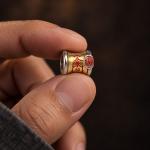
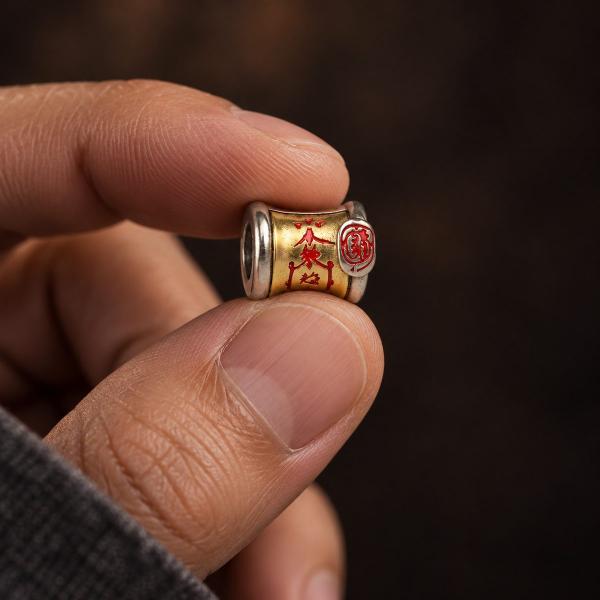
The two characters chiling are the opening of a talisman. On a Daoist talisman, chiling is written before the drawing begins, meaning to act on the order of the deity; the specific spell and the sacred names come after. Only when those two characters are written with force does the whole talisman stand up. Their place is fixed, at the head of the spell, set larger than the body text and written in one continuous movement. Folk talisman writing has the saying, a dot like a peach, a downstroke like a knife, which is about the momentum of the brush rather than the shape of the character.
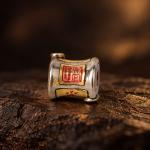
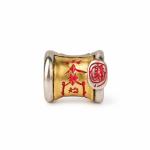
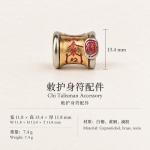
Moving the chiling pattern onto a barrel bead is a recent habit among bead collectors. The characters should look like talisman writing, not shop signage: strokes joined, ends tapering to a point, horizontals with a slight lift. Cut on a cylindrical face, the design unrolls flat and has to meet again when it rolls up, and the layout is the fiddly part. A cylinder unrolls into a rectangle, so the spacing has to be calculated along the unrolled length; otherwise one end is crowded and the other loose once it is rolled. The flat ends have to be ground true, or the bead will not sit against the main beads and will wobble.
The red lacquer is the other point. Vermilion is a colour that holds its ground in tradition: cinnabar for talismans, red lacquer for objects, the same logic underneath. The lacquer must be even. Too thick and it pools, too thin and the copper shows through, and the edges are where the ground shows first. Red lacquer is usually laid over a primer, and if the primer is uneven no thickness of red will hide it; it comes through with time.
As a fitting, a barrel bead usually takes the top bead or the waist bead position. Red lacquer against dark wood jumps, and one in a strand is enough; against a warm wood such as huanghuali, choose a deeper red or the two will fight. The top bead sits at the highest point of the strand, where the colour jumps most and is seen most, so nothing about it can hide. Waist beads can go in pairs, set symmetrically; the top bead is single.
Lacquer dislikes knocks and long soaking. Chip a piece off and the copper underneath shows, beyond repair, and the bead has to be replaced. Taking it off to wash your hands or shower is the cheapest way to extend its life. With pieces that carry writing, look at the writing first. Loose, slack characters mean the drawing was never right, and there is no point examining anything else. Deep cuts, clean turns and a tidy lacquer edge: pass those three and the piece is sound. Lacquered copper is not for daily handling, since sweat and oil make the lacquer tacky and it only darkens with fondling.