


Menu
By theme
By theme


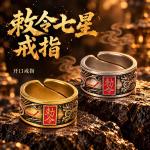
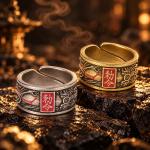
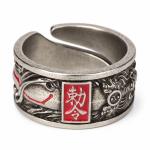
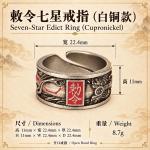
{{ variable.name }} : {{ variable.values[selectedVariantsIndex[variable_index]].name }}
Quantity:
The seven stars are the Northern Dipper: Tianshu, Tianxuan, Tianji, Tianquan, Yuheng, Kaiyang and Yaoguang, seven points joined into the shape of a wine ladle. In old times people read the Dipper for direction and divided the seasons by it; Daoism places it under Doumu Yuanjun, and it appears throughout the liturgy. Its orientation turns with the year: handle pointing east is spring, south summer, west autumn, north winter, the oldest calendar there is. Beside Kaiyang there is a small companion star that good eyes can see, and in old times it served as an eyesight test.
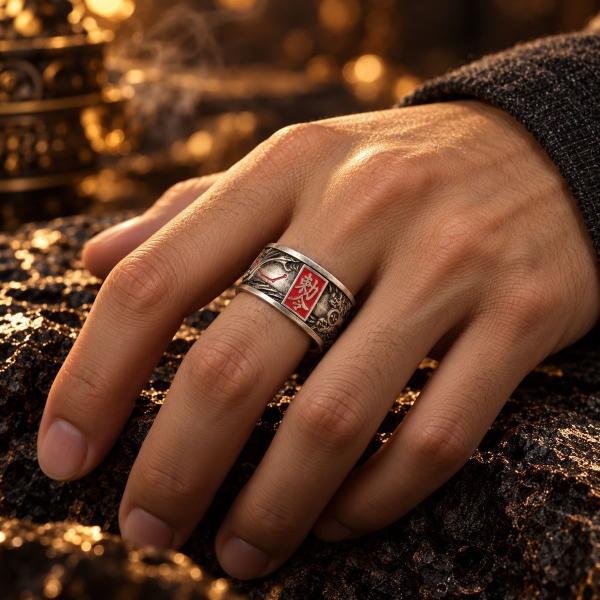
On a ring the seven stars are usually seven small dots joined into the ladle shape, or seven raised bosses set in a row. Dots are easy; bosses are hard, since all seven must be the same size and height with even spacing, and if one shrinks in the casting the whole ladle falls apart. Set the seven on an arc and the shape appears; set them in a straight line and no amount of even spacing will make it read.
Chiling and the seven stars together are a common Daoist pairing: command on one side, direction on the other, and together a complete set of symbols. Not everyone who wears it understands, but the pattern itself has been thought through. Daoist objects often assemble talisman writing, sacred names, stars and seals into one set; a single element is a pattern, the full set is a system. Folk usage also calls the seven the Lords of the Northern Dipper, each with its own charge, and the accounts are tangled. The spacing of the seven is fixed; the maker can vary the weight but never the position.
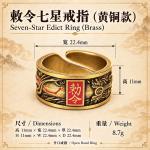
A white copper ring, in white and yellow. White runs cool and goes with silver jewellery and plain clothing; yellow runs warm and works with leather cords and wooden bead strands. The inside of the band has to be polished smooth, since a rough inner face raises a red mark within a day. The inside is where craft shows most: when someone takes trouble over the part no one sees, the rest will not be far behind. Both colours have a rounded inner face that does not scrape the finger, and that matters more than the pattern.
The worst way to buy a ring is to guess from the size number. Finger circumference shifts through the day, a little thicker in summer than in winter, so take a middle reading, and anyone with prominent knuckles has to measure past the joint. An open design can be adjusted; a closed one has to be right. On a ring with a dense pattern, soap residue collects in the recesses and shows white; scrub it with an old toothbrush and a little hand soap, rinse and dry, which is less trouble than polishing and does not wear the pattern down. There is no rule about which hand; the dominant one takes more knocks and wears faster.