


Menu
By theme
By theme

{{ variable.name }} : {{ variable.values[selectedVariantsIndex[variable_index]].name }}
Quantity:
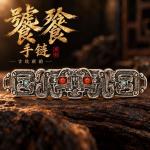
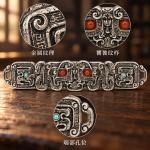
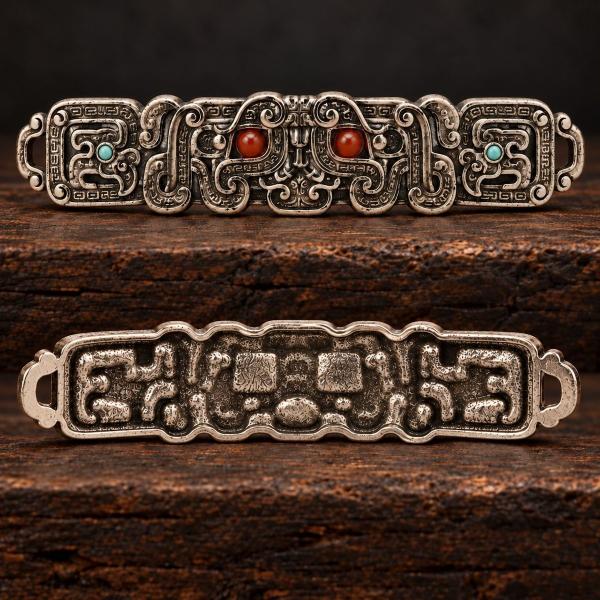
The taotie pattern is the animal-mask motif on Shang and Zhou bronzes: a pair of large eyes, a wide-open mouth, laid out symmetrically to either side, often with no chin at the centre. The motif runs from the Erligang period down to the Warring States, simple early and elaborate late. Song scholars compiling the Xuanhe Bogu Tu gave it its name from the Lüshi Chunqiu line about the Zhou ding bearing taotie, a head with no body, and the name has held ever since.
Strictly speaking, what to call this motif on bronzes is still argued: some scholars say animal mask, some say taotie. In the trade there is no need to settle it, because what is recognised is the image: big eyes, thick horns, wide mouth, symmetrical face, an oppressive presence. Once you can read that set, other beast patterns become distinguishable. In the Zuozhuan, taotie is one of the four fiends, greedy for wealth and for food, who in the end devoured itself and was left with only a head, which is where a head with no body comes from. After the Song naming, Ming and Qing jade and wood carving kept the term while the pattern grew softer and softer.
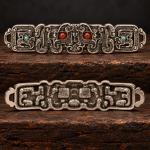
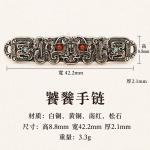
The plaque bracelet is one form of wrist strand, its main element a rectangular or oval plaque with beads or cord on either side. The plaque is wider than beads and sits face outward on the wrist, so the pattern has to read clearly. This one is a dragon plaque, the dragon's body coiled over the face, the scales pressed out one cell at a time, the back usually plain. Dragon plaques mostly show the dragon frontally, the upright dragon, for dignity; a turned body is the walking dragon, for movement. The two have different temperaments and suit different occasions.
Casting a thick white copper plaque, the difficulty is even thickness. Thick areas cool slowly and sink, and a sink leaves a hollow in the face that can only be levelled by grinding, which thins the pattern if taken too far. Look at the face under raking light when it arrives: smooth undulation with no dark hollow anywhere and it passes. On a thick plaque the cord hole has to be drilled deep; a shallow hole wears the cord quickly and tends to chip at the edge.
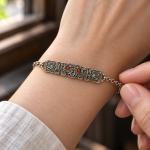
A plaque bracelet is heavier than a bead strand, and anyone used to beads will feel the weight for the first few days. Measure the wrist accurately, keep the plaque outward, and leave a finger's slack: too tight and it presses the bone, too loose and the whole thing spins, carrying the pattern round to the inside of the wrist. The back usually carries a slight curve to sit against the arm; without it, long wear digs in. Do not wear it on the same wrist as a watch, since two hard objects rubbing will always mark the plaque first.