


Menu
By theme
By theme

{{ variable.name }} : {{ variable.values[selectedVariantsIndex[variable_index]].name }}
Quantity:
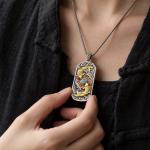
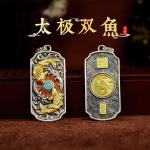
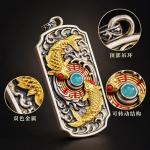
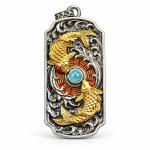
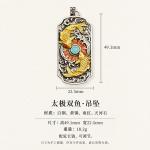
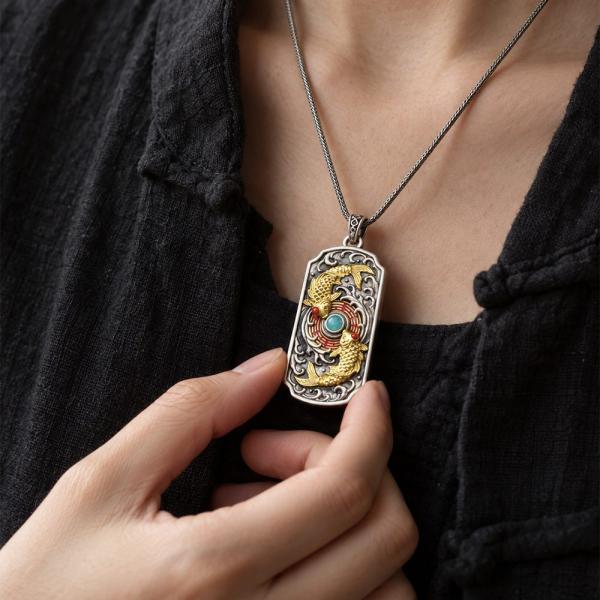
The double fish is older than the taiji diagram. Han relief stones already carry a composition of two fish chasing each other head to tail, standing for unending generation; folk usage later added the pun on surplus year after year, since fish and surplus sound alike, and it is used most at festive occasions. The two yin-yang fish of the taiji diagram belong to the same family in form, one speaking of circulation and the other of pairing. They are also given as a pair, one each.
Putting double fish and bagua together is a common assembly within the Daoist symbol system. The bagua fixes direction and the fish speak of circulation, one still and one moving, and the surface does not go dead. On a pendant the bagua usually sits in the outer ring with the fish drawn into the centre, the layers closing inward so that the eye has somewhere to land. The trigrams are set either in the Earlier Heaven or the Later Heaven sequence: the first speaks of opposition, the second of circulation, and jewellery mostly takes the Later Heaven because its directions match a compass.
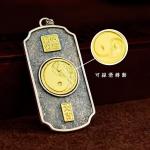
A white copper round plaque in low relief, which is to say shallow. Shallow relief is read in line and plane rather than volume, blurs easily under flat light, and needs to be seen from an angle. Such pieces do not suit a bright polished chain, since competing reflections make the pattern harder still to read. The edges of the relief must stay crisp; once they blur, the pattern cannot lift off the surface. The face is not mirrored, and the two eyes of the taiji are left recessed and darkened so that the figure separates. In shallow work a plaque that is too thin has to fall back on incised lines, and an incised design looks flat at a distance.
Options with a chain and without. The chain supplied is usually a plain one, close in colour to the plaque and not competing; the version without suits a cord of your own, leather, cotton or braid. The hole is at the top and not large, so a thick cord will jam; ask before buying and save yourself the trouble. The chain gauge should match the plaque: too fine and it cannot carry it, too heavy and it looks clumsy. With a braided cord, choose a flat knot with the knot face outward for a clean finish. If you take the chain, a lobster clasp is easier on and off than a spring one.
As a gift, the double fish is easier to offer than plain bagua. Say bagua and the other person thinks of fortune telling first; the double fish is an auspicious pattern that anyone can accept. If you do explain a meaning, talk about circulation and about having enough to spare, both good words, and there is no need to drag efficacy into it. Worn against the body the plaque does not dig in, and in winter it does not fight a high collar, which makes it easier than a thick plaque.