


Menu
By theme
By theme

{{ variable.name }} : {{ variable.values[selectedVariantsIndex[variable_index]].name }}
Quantity:
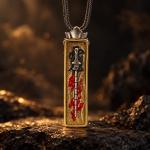
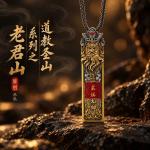
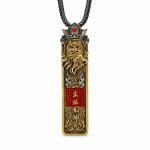
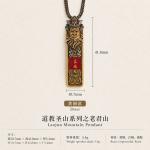
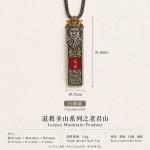
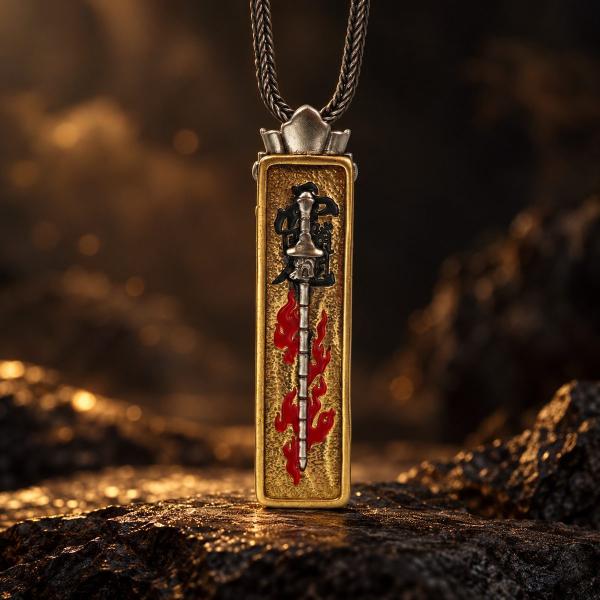
The ridge of Laojun Mountain looks layered from a distance: on a clear day you can count three or four ranges of shadow, and when cloud comes up only the peak is left. Relief carvers like a mountain of this sort because the layers are already there and need no invention. This piece presses those layers into one plaque, steps in the foreground and the summit hall far off. The steps are the most legible thing in a mountain scene, laid one above another, dense but not muddled, and most makers spend their effort on that stretch. Only one hall appears on the face, shrunk very small, to set off the height of the mountain rather than to draw a building. Cloud comes up fast in these mountains, and seeing and not seeing are two different things; the little cloud left on the plaque means exactly that.
The phrase sacred mountain places it within the order of Daoist famous peaks. Beyond the Five Peaks, Daoism has a further set of grotto-heavens and blessed places, each with its own charge, and Laojun Mountain is one of them. These accounts are scattered through the mountain gazetteers of various houses, the entries differ and the numbering does not agree, so there is no need to press for precision; it is enough to know that the mountain is treated as a holy site.
Low relief builds its layers out of differences in height, and a small difference brings the far mountain forward. The hardest part of a mountain scene is the empty space: put the cloud in the right place and the mountain gains distance, put it wrong and the plaque becomes a map. This one is restrained with its cloud and does not fill the whole face. The thickness of the plaque decides how many layers the relief can carry; too thin and there is only incised line, with no height at all. Cloud usually sits at the mountain's waist: too high and the mountain breaks, too low and the foot disappears.
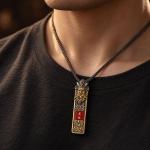
The options are pendant and necklace, each in white and yellow. A pendant is best on a cord, since a mountain scene is a vertical composition and the cord hanging from the hole keeps the picture upright; the hole sits at the top, at the peak, for exactly that reason. A metal chain works too, but the chain swings and the mountain shadow swings with it, which tires the eye after a while. Choose a dark cord, which holds down the grey tones of the scene.
It suits an elder, especially one who has been up the mountain. No explanation is needed, since he recognises the mountain on the plaque and the conversation starts itself. At that point you only need to say that it is cast in white copper and that the relief carries several layers, and he will tell you the rest. Subjects like this move slowly in a shop, and the buyers have mostly been there themselves or have an elder at home who holds with it.