


Menu
By theme
By theme







{{ variable.name }} : {{ variable.values[selectedVariantsIndex[variable_index]].name }}
Quantity:
A strand may hold only two or three spacers, yet they do the work of punctuation. Put one bead of a different material or colour between the others and the eye pauses there, and the rhythm of the whole strand arrives with it. Spacer materials are various, wood, stone, glass and copper among them, and enamel is the loudest in colour. The hole must be true; off centre and the strand pulls to one side, more obviously the longer it is. The usual order is main bead, spacer, main bead, and spacers are not set two in a row.
Enamel is filled onto a copper body and fired in, not painted on. Fired colour sits deep: red becomes dark red, blue becomes sapphire, without the floating brightness of lacquer. Well-filled enamel has a level surface and even colour, with the wire or the body wall clean at the edge; badly filled, the glaze carries pinholes and the colour runs light and dark in patches. Enamel fires at a high temperature and a thin copper body will warp, which is why enamelled pieces are usually made thicker. Enamel red divides into vermilion and date red: vermilion is bright, date red is deep, and old beads call for date red.
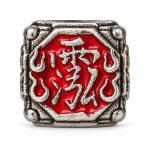
This one has a white copper body with enamel on the outer ring. Spacers mostly take a barrel or drum form with flat ends, which sit tight against the main beads and leave no mark. The hole is centred so that the cord runs straight. Used as a fitting, it usually goes between main beads or either side of the three-hole bead as a transition; a barrel locates better than a sphere and does not roll in the strand.
There are not many rules on colour, but one holds: no more than two enamel colours in a strand. More than that and the main beads are overwhelmed. Dark wood beads are steadiest with date red or sapphire, pale bodhi with moon white or bamboo green and other light tones. Enamel colour should agree with the metal underneath: white copper runs cool, so sapphire and moon white are safest; brass runs warm, so date red and ochre suit it better. Spacers within one strand should be the same size, since mixed sizes break the rhythm.
In care, enamel fears knocks. Chip a piece out and the glaze has a gap that cannot be filled, only replaced. Store it apart from hard objects and do not let it share a pouch with keys or coins. Wash in warm water with a little neutral detergent and dry with a soft cloth; skip the ultrasonic cleaner, since repeated vibration loosens the glaze. Buy one spare when you buy your fittings, because chipped enamel cannot be repaired and a swap is the easiest way out.