


Menu
By theme
By theme





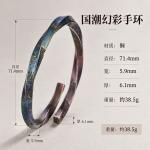
{{ variable.name }} : {{ variable.values[selectedVariantsIndex[variable_index]].name }}
Quantity:
The Tianpeng ruler is one instrument among Daoist ritual implements, mostly wooden and sometimes bronze. The face usually carries constellations, spell text or ritual line patterns, and both ends are shaped as cloud heads; it is held in the hand during rites, used to measure, to subdue and to accompany the footwork of the liturgy. It is not a ruler for daily use but an object for performing rites. In Daoism the ruler does more than measure length: in liturgy it marks a boundary, drawing a line on the ground, and it also holds the space. Making a bangle from a bronze ruler takes a section of the implement's form, keeps the cloud pattern of the head and bends the body into an arc.
The name Tianpeng comes from the four saints of the Daoist Northern Emperor tradition: Tianpeng, Tianyou, Yisheng and Zhenwu. Tianpeng heads the group and governs the northern exorcism court. Old novels make Tianpeng the earlier incarnation of Zhu Bajie, but that is another story and not the Tianpeng of the implement, so do not run the two together. The four saints took fixed form in the Song, honoured by both the Northern Emperor and the Shenxiao traditions, with the order slightly different between houses.
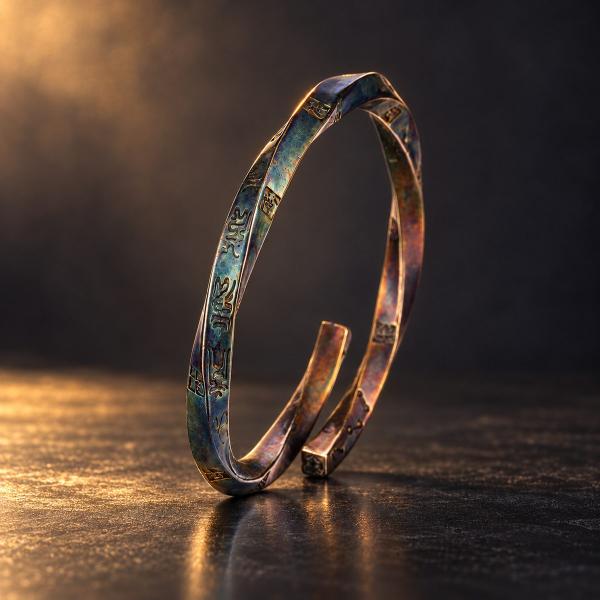
Made into an open bangle, it moves from ritual implement to ornament. The body is bent into an arc with the opening on the inside of the wrist, and it can be eased open a little, which makes it easy to put on and take off. Brass is ductile and will not break after a few bends, but bend it often and it goes slack, and once slack it no longer sits against the wrist. The two ends of the opening should be rounded, since a round end does not hurt the skin and survives bending. There is a limit to how far an open bangle should be sprung: past three tenths and it deforms for good.
The scale marks on the face are the point of the thing. Cut deep, they cast a shadow and read segment by segment in the light; cut shallow, they are a single scratch at a distance. Brass runs warm in tone and darkens with wear, the recesses blackening first while the raised parts polish bright, so the scale marks actually grow clearer. Brass has heft, and at the same gauge it feels heavier than it looks. Dirt settles in the deep cuts, so brush along the lines; brushing across only pushes the dirt in.
An open bangle forgives size better than a closed one, and a wrist a little either way can still wear it. When choosing, check whether the ends of the opening are chamfered: an unchamfered edge is thin, catches clothing and catches the hand. It is a small detail, and a single day of wearing shows the difference. Bangles like this are not for stacking, since the open edge rubbing against another bangle damages the cut pattern first.