


Menu
By theme
By theme

{{ variable.name }} : {{ variable.values[selectedVariantsIndex[variable_index]].name }}
Quantity:
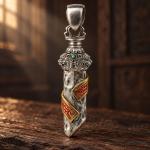
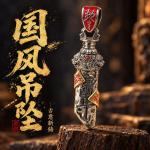
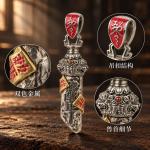
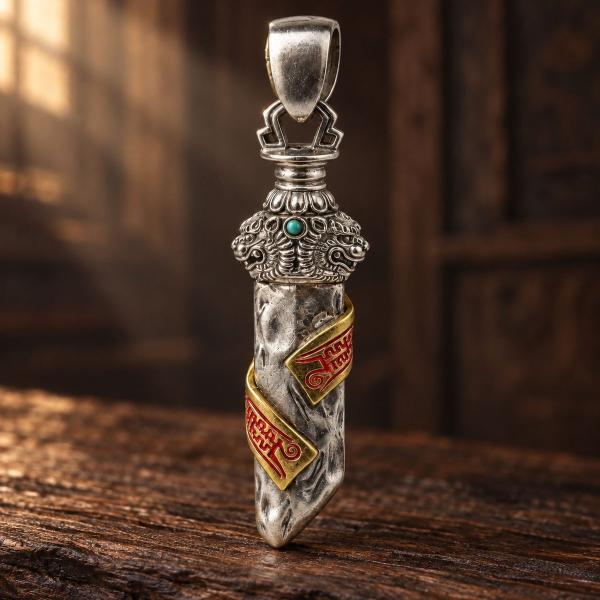
Thunder rites took on a formal system in the Song dynasty. The Shenxiao school sorted the thunder deities into a roster of shifts, and the ritual called for a command tablet. The thunder command was that tablet: a talisman cut on one face, characters on the other, the characters set large enough to be read at a glance. Nor is the sword in Daoist practice a weapon. It is a ritual blade, made to point out direction and fix position, narrow in the body and blunt at the tip, never intended to wound. Both altar objects have been scaled down to a little over an inch and turned into one pendant, with the proportions kept as they were. Old tablets were usually jujube wood and the swords copper, one wood and one metal, each with its own office.
White copper reads cool; it does not warm the moment it touches skin the way brass does. The beast head sits at the top of the hilt, brow ridge pressed low, eye sockets deep. Head-on it is a mass of shadow, and only when you turn the piece to the side do the teeth come clear. The blade is narrow and long, the talisman characters set down along the spine, strokes sunk below the face so that light breaks across them in separate bright lines. This cutting costs more work than flat carving: the graver travels twice, the first pass setting the shape, the second pressing it deeper. The gain is that the characters outlast wear, so that half a year on you still have letterforms rather than an outline. Thickness matters as well. Too thick and the plaque will not lie flat against the chest; too thin and it deforms.
The two options differ only in the fittings. Take the pendant alone if you already have a cord or chain to hang it from; take the necklace and the chain comes matched, so you are not measuring a hole against a chain gauge. Sword pendants share one common fault: turned sideways, they flip. A chain that is too fine cannot hold one down, which is why the pre-matched necklace sits steadier. Length can be noted on the order. Shorter reads cleaner; longer tucks inside a collar. Cords are another matter. Red against white copper leans folk, black runs colder, leather wears longest.
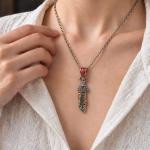
Point down is the usual way to hang it, at a length that lands mid-chest, lying against the fabric as you walk with very little swing. Worn outside a crew-neck sweater it stays put and, being narrow, does not shout. Tucked into a shirt opening so that only half the hilt shows counts as a way of wearing it too. Against bare skin in summer, white copper warms slowly and gives a brief chill that passes in a few minutes. It suits men; on women it reads harder, which comes down to the person. The pendant is light enough that it will not drag a thin shirt out of shape.
White copper dislikes sweat and dislikes damp. In summer, press the face dry with a cloth when you take it off. The gaps between the beast's teeth and the grooves of the characters hold sweat longest and go dark first. Store it on its own instead of in a heap with keys; white copper is soft, and one knock leaves a small dent that no amount of polishing will take out. It is a nickel-bearing alloy, and a minority of wearers find their skin reddens after long use. If a rash appears, stop wearing it. Use a cloth that does not shed lint, because paper fibres wedged into the cuts are hard to shift.