


Menu
By theme
By theme




{{ variable.name }} : {{ variable.values[selectedVariantsIndex[variable_index]].name }}
Quantity:
The old custom of seven grains of rice is taken seriously in both north and south. Rice heads the five grains. Seven grains were wrapped in red paper or red cloth and sewn into a small pouch hung on a child, which the older generation called settling a fright. Seven is a number folk practice uses often — seven stars, seven treasures, seven times seven — for the sense of a cycle completed. How the packet is made varies by region: some add a pinch of tea and salt, some put in rice and nothing else. Travellers carried one too, a packet of rice for the road.
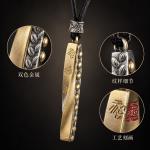
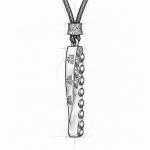
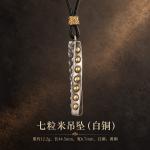
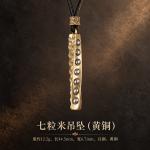
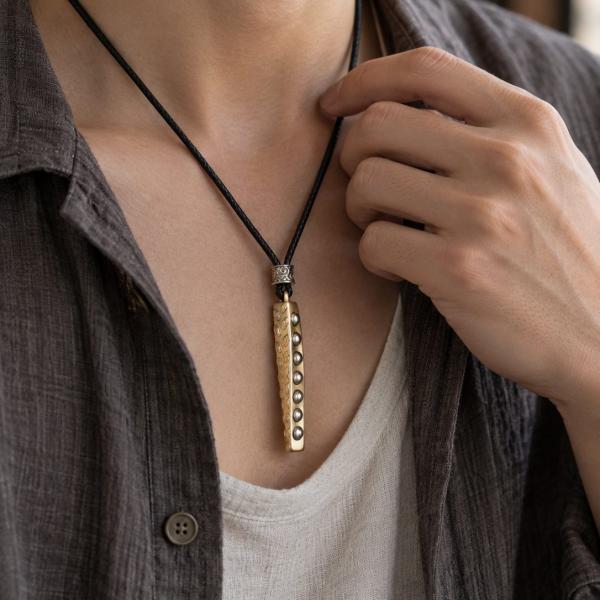
The pendant is a narrow rectangle, with the seven grains set in two rows across the face. Each grain stands in relief with its edge rounded off, so the surface does not scratch. Copper, in brass or white copper. Brass runs yellow, white copper runs silver-grey; the same motif carries very differently in the two, the yellow reading as an old piece and the white as something newly struck. All four corners are rounded so nothing catches on clothing. The face is convex, the back flat, and the side that touches skin carries no engraving.
A rectangle lies against the chest better than a round pendant. It has more surface to rest on and turns over less. There is one hole at the top, not large: fine cord suits it, a heavy chain looks cramped. If you supply your own cord, keep the end thin. Forcing a thick end through will split the hole, and a split hole cannot be repaired, only replaced. The plaque is thin enough to disappear under a shirt. Cotton or waxed cord works best; nylon is slippery and its knots come undone.
A motif like the seven grains is about having the thing, not about resembling it. The grains are not carved realistically; each is only a small rounded bump, and you have to come close to see what they are meant to be. The abstraction wears better than a literal carving, which tires the eye over time and loses its shape altogether once worn. Look long enough and you notice the bumps are not quite the same size, which is normal in hand-finished work. The face keeps a lot of empty ground, no crowding of characters or pattern, and that is why it holds up to repeat viewing.
Worn against the body, a copper pendant shows colour change within a month on anyone who sweats freely. The raised parts brighten first and the recesses darken first. To clean it, wrap a soft cloth over a fingertip and press; do not dig at the grooves with a nail. Brass has a stronger smell than white copper and leaves a faint metallic trace on the hand, so anyone sensitive to that should choose white copper. Brass yellow sinks slowly with wear, while white copper drifts toward grey.