


Menu
By theme
By theme

{{ variable.name }} : {{ variable.values[selectedVariantsIndex[variable_index]].name }}
Quantity:
Padmasambhava was a monk who came to Tibet from India in the eighth century. The Nyingma school honours him as its founder, and that school is the oldest branch of Tibetan Buddhism. In Tibetan painting he usually holds a skull cup in the left hand and a vajra in the right, sitting at ease with the right leg slightly extended rather than in the full crossed posture of Chinese Buddhist figures. A half-length quill stands at the tip of his hat, one of his identifying marks. Once the image reached China proper it was made into small fittings of every kind.
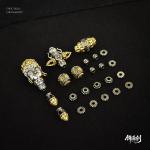
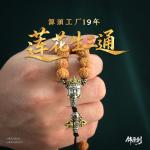
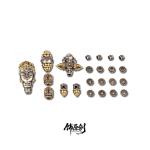
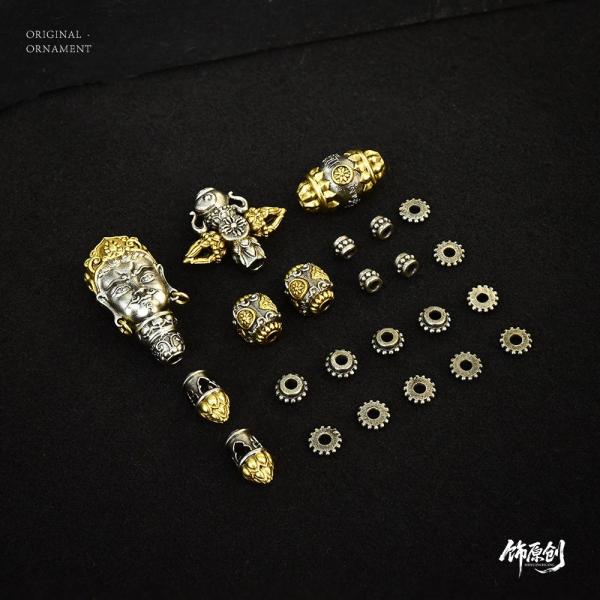
This is a three-hole bead, the fitting also called a guru bead, used where a bracelet or mala closes. The holes form a T: two strands enter from the sides and one leaves from below, gathering the whole string, and the lower hole takes the buddha head or the disciple beads. Its other name is simply buddha head; the word differs, the position does not. It has to sit exactly at the centre when strung, because one bead off and the balance of the string goes with it. Whether one disciple bead hangs below or two depends on the length of the string.
The white copper figure sits on the face of the bead in low relief. The face is carried by a few lines only, one cut for the brows, one for the bridge of the nose, one at the corner of the mouth, and one cut too many would blur it. On a small piece, shallow relief is more practical than high: it does not chip off and does not catch on a sleeve. The face is left without a highlight, and the darkened oxide around it draws the outline. Images of Padmasambhava are not common in China proper, and his face is rounder than the usual Chinese Buddhist type, the brows and eyes set wider.
The holes are cast and may carry fine burrs. Run a finger through before threading; if it catches, turn a drill bit through a couple of times by hand. Copper oxidises, and the face pressed against the beads dulls first, which does no harm, so wipe it when you restring. Do not use cord that is too thick: two strands through the T is already the limit. Singe the end of the cord and twist it to a point before threading, which makes the holes much easier.
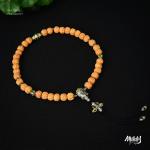
When building a string, the three-hole bead should be one size larger than the main beads. Smaller and it cannot hold the string down, and the whole thing looks light at the top. On colour, white copper is cool and works with dark wood beads or bodhi root; warm stones such as southern red agate will fight it. Keep the palette to three colours at most, because more turns busy. Round main beads next to an elongated three-hole bead give the eye something to break on; main beads and a fitting of the same colour make the head impossible to pick out from a distance.