


Menu
By theme
By theme



{{ variable.name }} : {{ variable.values[selectedVariantsIndex[variable_index]].name }}
Quantity:
A spacer bead is punctuation in a string. Beads graded from large to small need a pause in the run, and that is the work a spacer does. It also protects: two hard beads set against each other will wear pits into one another over time, and a single bead between them prevents it. Both functions are treated seriously in the rules for malas, which means a spacer is not added at random. It should be a little smaller in diameter than the main beads. Larger and it steals attention from them; smaller and it vanishes into the run. Old strings often change material at the spacer, precisely to mark the sections.
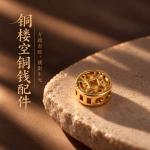
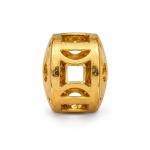
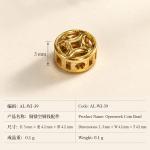
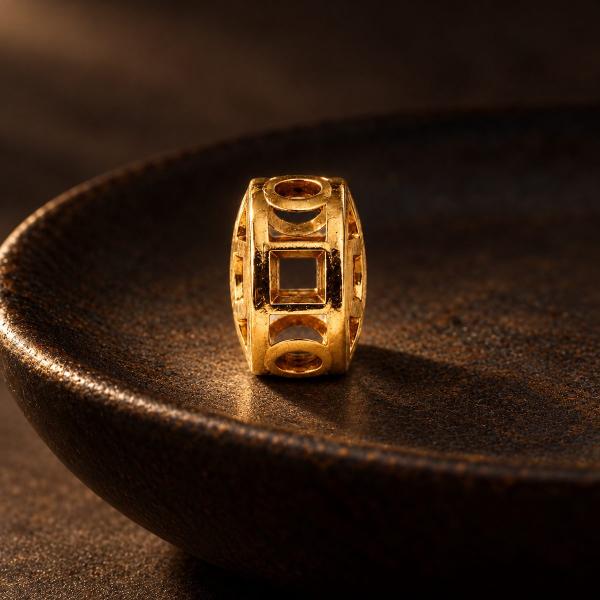
This one is a coin-form spacer in white copper, inscribed on both faces, with the bore drilled for ordinary cord and wide enough to take two strands. A coin is thinner than a round bead and takes up little length on the string, which makes it useful as a transition between main beads and accent beads without disturbing the spacing you have worked out. Being cut on both sides, it needs no turning to face outward, which saves trouble over a single-sided piece. The strokes are shallow, and set among beads they only show when the string turns in the hand. Cutting both faces costs more work than one, and the price reflects it.
How many to use depends on the length. A bracelet usually takes two; a mala places them by section, four spacers to a run of twenty-seven beads. Too many and the string looks cluttered; too few and there is no rhythm to see. White copper is cool, so against warm beads it lifts the whole string, and against cool ones it sinks in and the result looks dull and closed. Spacers conventionally sit at the one-third and two-thirds points. Where a string is all one colour, the spacers can carry the contrast instead.
The edge of a coin spacer is straight, so the cord runs against the rim and frays over time. Before stringing, turn a little fine abrasive paper through the mouth of the hole to take off the sharp cast edge, and the cord will last considerably longer. Left alone, the cord saws back and forth in the hole, and that is where a string breaks first, usually at the least convenient moment. Cord choice matters too: elastic wears quickly, nylon is strong but stiff. Pick according to how the string will be used, not by what is already in the drawer.
Thin white copper distorts easily. A coin form is open in the middle, and pinching the edges will crush it, so when taking a string apart use pliers on the rim and never on the face. Oxidation needs no attention; a spacer buried among beads is not conspicuous to begin with, and a little darkness in the cuts reads as depth. If it must be washed, rinse it along with the beads rather than soaking it separately. Nor should a thin piece like this go into an ultrasonic cleaner, which will loosen the fitting and pull it out of shape.