


Menu
By theme
By theme


{{ variable.name }} : {{ variable.values[selectedVariantsIndex[variable_index]].name }}
Quantity:
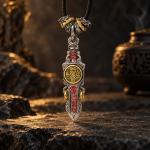
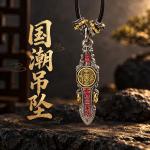
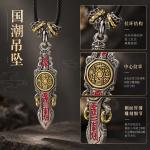
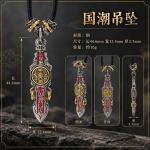
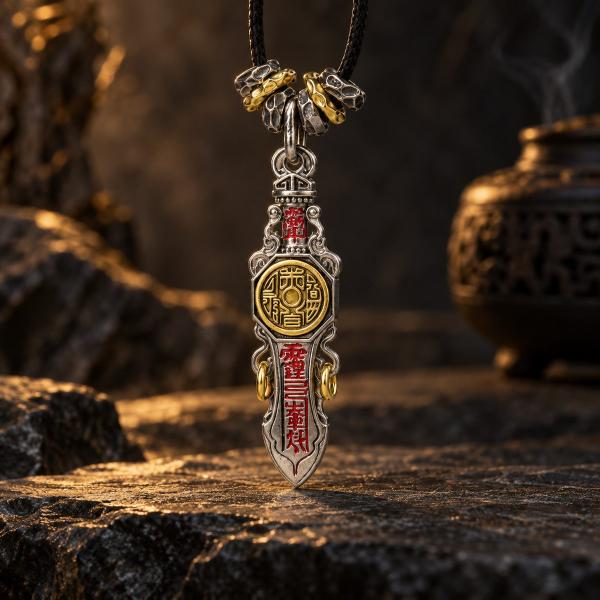
The plaque follows the outline of a command arrow: broad at the top, narrowing as it descends, the tail cut to a point. A sword is struck on the face in relief, its blade ridge raised, the guard set low, the point turned down and overlapping the tip of the arrow. The white copper ground runs cool, the raised ridges polished bright while the recessed field stays dark, and it is that split of light and shadow that makes the sword stand up. The back is left plain, with only an arc drawn in around the cord hole. The plaque is shorter than it is wide, so on the chest it lies as a horizontal block rather than a vertical bar.
The arrow token was a credential for passing orders in the old army. An arrow-shaped object held in the hand meant the words had arrived. Putting that shape on something carried every day says it more plainly than carving the character for command. The ritual sword belongs to another current of Daoism: the blade of the Seven Star Sword is inscribed with the Big Dipper, and the two sides of its ridge are divided into yin and yang. Set together on one plaque, the two read as a pair — an order given, a matter settled — and it is enough that they answer to whatever the wearer has in mind. Messengers used to tuck the arrow into a belt; the arrow was the warrant, and no one asked who carried it.
White copper is a little harder than brass, so the graver has to move slowly; push it fast and the edge chips. The single ridge along the blade is where most of the work sits. The two bevels either side have to be symmetrical, because a small error shows the moment light crosses them. The ground was not taken to a mirror finish. A fine sand texture was left in it so the raised parts read stronger by contrast. The perimeter is chamfered, which keeps the cord off the ridge. The guard block is made separately and set in, not cut from the same body; the joint sits on the side.
It comes as a standard piece only, without a chain. If you have a cord, match it yourself: a thick one carries the weight of the plaque, a thin one makes the whole thing look top-heavy. It sits best a little below the collarbone, where it stays put as you walk. The hole is not large. A doubled cotton cord passes; a braided cord needs to be a thin one.
Both the sword point and the tail of the arrow are thin, and both will bend if they catch a table edge. Do not take it off and leave it on the desk; put it on a small dish or back in its pouch. White copper dulls at the touch of sweat, a haze coming up over the face, and a few presses with a dry cloth bring it back — do not go at it with a wet wipe. Dust settles in the recesses; sweep it out with a soft brush in one direction rather than rubbing back and forth. Once the patina builds, the ridge brightens first and the ground follows.