


Menu
By theme
By theme


{{ variable.name }} : {{ variable.values[selectedVariantsIndex[variable_index]].name }}
Quantity:
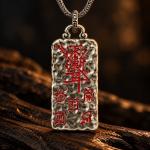
The True Form Chart of the Five Sacred Peaks is preserved in the Daoist canon. Its five symbols each stand for one mountain; they are not a map and not realistic outlines of the peaks. The chart notes directions, heights and the produce of the mountains, all enclosed in talisman-style writing that looks like characters without being them. People took the chart seriously in older times, and carrying it into the mountains was the custom of the day. The five peaks run from Tai in the east through Heng in the south, Hua in the west and Heng in the north to Song at the centre, each holding one direction.
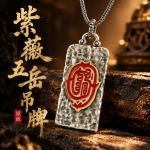
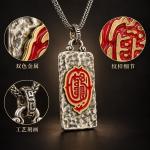
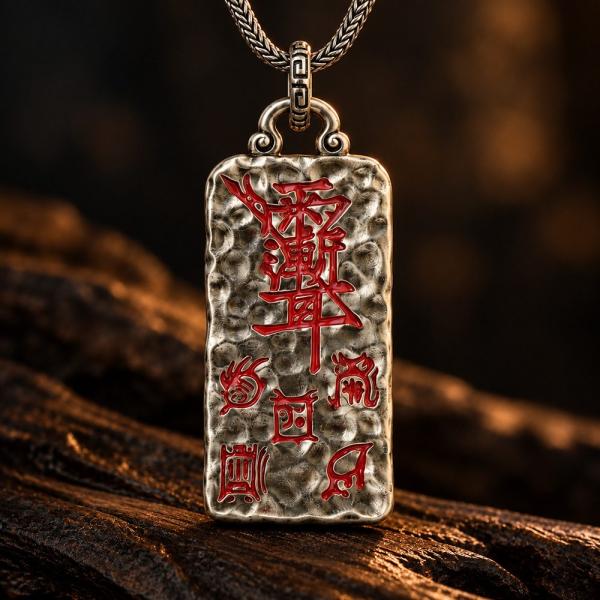
The plaque is square with rounded corners, thick at the centre and thin at the edge, like a seal that has been pressed flat. One face carries the five mountain symbols, each in its own place with small characters between them; the other face is given over to two large characters in square-cut strokes that fill it edge to edge. A hole at the top takes a cord or a clip. The five symbols are not evenly spaced: the large one sits at the centre and the smaller ones toward the corners.
On a plaque worked this densely, the difficulty is keeping the five symbols distinct. Their lines curve and then turn, one stroke lying over another, and packed too closely they become a single blot. Here the ground behind each symbol was cut down a little so the lines lift off it, and enough bare metal was left between them: from a distance five masses, close up one stroke after another. The turns are where blurring starts, and with several dozen bends across the five symbols, every one had to come out clean.
Two versions are offered, one the plaque alone and one with a chain. The chain is not heavy, and it carries the plaque's corners without pulling them out of shape; the plaque on its own suits anyone who already has a cord, and leather and cotton both work. A square plaque hangs more steadily from a round chain than from a twisted cord, and square against square looks stiff. The chain is fine and the plaque has weight, so it drifts to one side over time; straighten it now and then. The clasp is a small ring that opens, so the chain can be changed.
The four corners of a square plaque take the knocks. A knock shows white, and the broken section of white copper is far brighter than the surface, so it is conspicuous. Mind table edges and car doors. The flat face collects fingerprints, and a dry cloth taken in one direction lifts them. Do not dig at the recessed ground with a toothpick; it scrapes away the dark and leaves new copper showing. Store it flat, and do not let one corner sit under pressure for long.