


Menu
By theme
By theme









{{ variable.name }} : {{ variable.values[selectedVariantsIndex[variable_index]].name }}
Quantity:
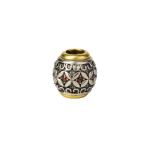
A spacer bead runs a size smaller than the main beads, flattened round, with a through hole and a continuous pattern pressed around its outer edge. The pattern stands very low. Once the strand is together it is more or less invisible; only turning the bead alone in the hand shows there is anything on the rim at all. Both side faces are flat, so they sit against the main bead without slipping. The hole runs straight through with no step, and the thread enters either end the same way.
Half of how a strand looks is decided by its spacers. A bead of another colour or another shape set between the main beads gives the eye somewhere to stop, so a long strand does not read as one unbroken line. Spacers also guard the holes of the main beads: set two large beads to grind directly against each other and the edge of the hole chips first. On old strands the spacers are often the finer pieces, made of the more expensive material. A strand in a single material goes dull on the eye, and two spacers wake it up. A shade darker than the main bead makes the break read more clearly.
Three versions are offered: white copper, brass and a Chinese-style pattern. White copper is cool and suits heavy colours such as lapis lazuli and South Red agate, holding them in place; brass is warm and looks right with old amber and dark wooden beads; the Chinese-style piece carries a fuller pattern and suits plain-faced main beads, where one is enough to lift the tone of the strand. Its pattern is fretwork and cloud scroll together, dense enough to read as a border of ornament from a distance. White copper and brass share the same pattern and differ only in material.
The hole is what matters most in a spacer. Drilled true, the strand runs straight; off centre by a little and the whole strand leans. All of these are chamfered at the hole, so the thread is not cut at the entry. A small hole suits fine thread; a large one needs a thin disc behind it, or the bead will slide on the thread and wear the wall oval over time. Thread frays as it ages, and frayed thread grinding in a hole cuts a groove. The discs are thin, sit between bead and spacer, and do not show.
A spacer is small, so it wears faster than the beads around it: caught in the middle, it is ground from both sides. A brass spacer develops a bright ring on each face where it meets the main beads. When it darkens, wipe it with a cloth, but do not put it in an ultrasonic cleaner, where copper goes dull all over. When you restring, turn the spacer to a new position so the wear stays even.