


Menu
By theme
By theme





{{ variable.name }} : {{ variable.values[selectedVariantsIndex[variable_index]].name }}
Quantity:
The skull is not a new subject in beadwork. Skull-shaped beads have appeared on Tibetan malas, where they are bound up with the imagery of protector deities and the skull is a ritual object rather than something meant to frighten. European rings carved with a skull are a reminder to keep death in mind, which Latin calls memento mori. The two lines of descent are different, and both come down to impermanence. A copper skull costs less than bone, will not crack, and adds noticeable weight on a strand.
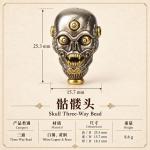
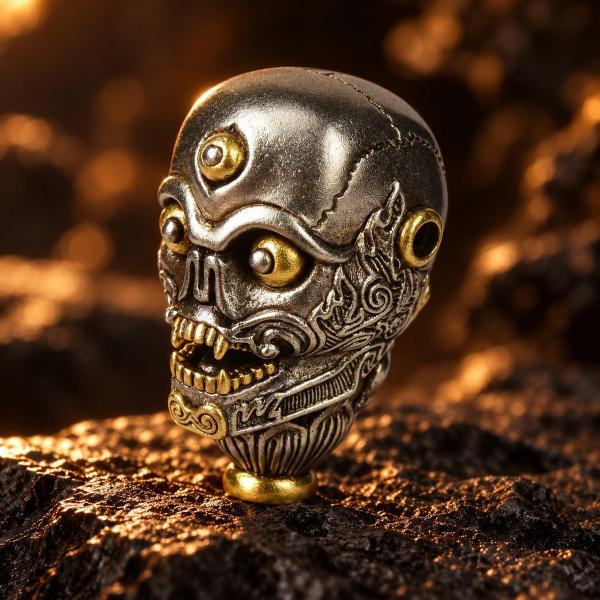
One skull: the hole is drilled at the crown, the eye sockets are deep, the nasal cavity is two small openings, and the upper teeth are separated one from another. The back half of the cranium is hollow with a thin wall, and looking in through the neck opening you can see the inside surface. From the front it seems to be smiling; from the side it looks more like bone; shift the angle and the impression changes again. The crown hole sits toward the back, so once strung the head tips slightly forward, and seen from the front it is looking down.
Where a bead like this goes matters. Under the guru bead it closes the strand; set in the middle of a long strand it breaks the rhythm; a single one paired with a plain bead makes a bracelet with a clear order to it. The hole is at the crown and the face turns outward, so the direction has to be right — get it wrong and you have a head on crooked. It sits better at the waist than at the neck, being three-dimensional and likely to press against the chest. A leather cord runs through, with the knot hidden inside the cranium where it cannot be seen.
The eye sockets are the hard part. They need depth without being pierced through, and the floor is rounded, so light entering leaves a layer of dark behind it. The teeth are the finest detail: each one needs a gap, and a shallow gap turns the row into a white block. Here the gaps are open and the tips are a little blunt, so they do not catch thread. The sutures at the back of the skull are two arcs meeting at the crown; the lines are shallow and disappear where the light is weak.
The sockets and the nasal cavity hold everything: sweat, dust, hand cream, mixing into a yellow film. Do not go at them with a cotton swab, because the fibres catch inside. Rinse with warm water, shake it out, and leave it in moving air overnight. Copper does not mind water; what it minds is water sitting in a hollow with no way out. Do not dry it with paper afterwards, since lint sticks in the gaps between the teeth — press it dry with soft cloth and blow the water out of the gaps.