


Menu
By theme
By theme





{{ variable.name }} : {{ variable.values[selectedVariantsIndex[variable_index]].name }}
Quantity:
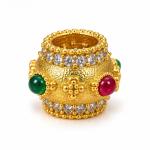
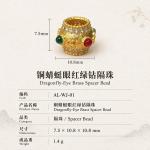
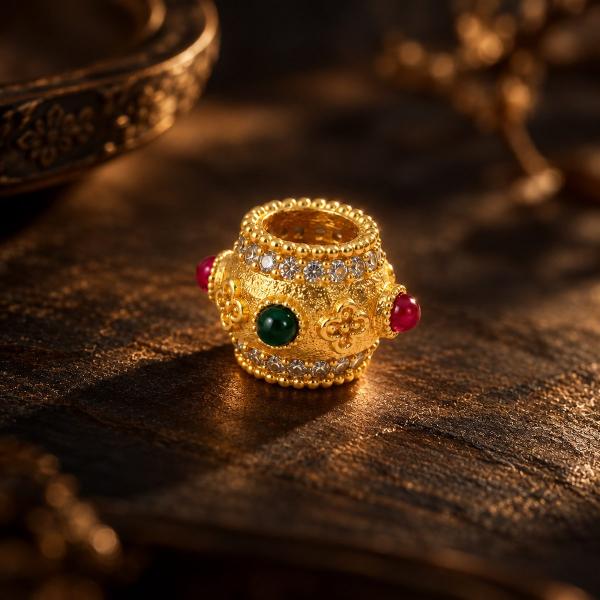
The bead carries an eye, one ring inside another, with a dark point at the very centre. The eye was not painted on but set in, and a very fine seam runs around it that a fingernail can feel. The body is polished round and flattened at both sides, so it sits against the neighbouring bead without rocking. The diameters are consistent, and a strand made from them does not run thick at one end and thin at the other.
The dragonfly eye is an old form in beadwork, named for the concentric rings that look like the compound eye of the insect. The early examples are mostly glass beads, found from the coast of the Mediterranean to the Central Plains, made by wrapping layers of differently coloured material one over another and grinding the result flat. Stone, jade and metal later took up the same device, and it became pure pattern. The number of layers varies: some eyes have three, some four or five, and more layers read deeper.
A spacer sits between the main beads, and one eye facing outward is enough; not every side needs one. With the eye turned out, a strand carries a few bright points that swing with the wrist and flash as you walk. If the eyes sit crooked the rhythm of the whole strand goes wrong, so each one has to be lined up as it is strung. The spacer's purpose is to separate the main beads: set two large beads to grind directly against each other and the edge of the hole chips first.
Inlay work fears two things above all: an eye that sits unevenly, and adhesive left in the seam. On these pieces the face of the eye is more or less level with the body, a few standing slightly proud, by as much as a fingertip can tell. The seams are open with no bead of glue squeezed out, which says the socket was dressed before the eye went in. The copper at the rim is pressed thin and a knock will turn the edge over. Polish the inlay lightly: too much and the eye goes cloudy, and once it is cloudy the concentric rings are broken.
The eye and the body are two different materials and expand at different rates, so coming in from the cold in winter the seam opens a little and closes again in summer. Do not soak the bead: water gets into the seam and, when the metal contracts in the cold, cannot get out, and in time it turns green. Press it with a dry cloth and do not circle over the face of the eye, which polishes a bright ring into the copper around it. In summer, with heavy sweating, a white bloom forms at the edge of the socket; that is dried salt, and a cloth takes it off.