


Menu
By theme
By theme



{{ variable.name }} : {{ variable.values[selectedVariantsIndex[variable_index]].name }}
Quantity:
The line through the middle of the taiji diagram is not a straight division but an S-curve, and the white fish is broad at one end and narrow at the other, with the black one the reverse. Only then does the figure turn smoothly; divide it with a straight line and the two fish are dead. A trigram is three lines: unbroken is yang, broken is yin, and eight groups of three account for all the directions. The directions of the bagua correspond to the eight solar terms, with the winter solstice at Kan and the summer solstice at Li, a pairing that appears in Han dynasty theories of qi and the trigrams.
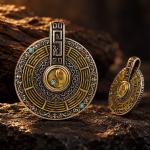
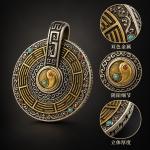
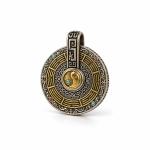
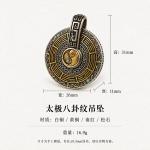
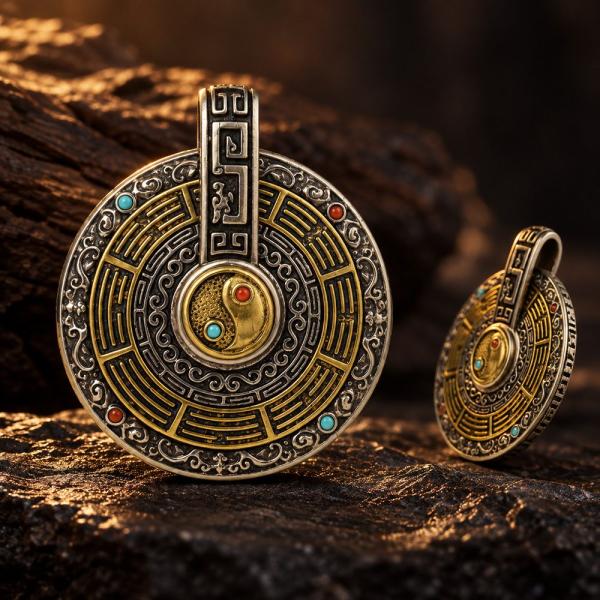
The centre of the round plaque is the taiji, the black fish and the white biting each other's tails, a point in each eye. Around it runs the eight trigrams — Qian, Kun, Zhen, Xun, Kan, Li, Gen and Dui — three lines apiece, filling the ring around the taiji. A narrow rim is raised at the edge of the plaque to hold them in. The hole at the top is cut in the rim and does not take up any of the design. The rim itself was turned on a lathe, evenly round, and a full turn shows no join.
Two versions are offered, one with a chain and one the plaque alone. The chain is fine, and the plaque turns as it hangs; at one angle the taiji stands upright, and turn it further and it sits crooked. Some people mind this and add a small ring at the hole so the plaque does not flip so readily. With the plaque alone you choose the cord, and a thick one holds it still. The clasp is a spring clasp that opens with a pinch. The plain version has a slightly larger hole, so a thick cord will pass.
With the taiji and the bagua cut on one face, the hard part is that a single line has to carry two meanings. The S is the boundary between yin and yang and also the inner circle of the trigrams, and where it closes and where it opens has to be worked out before the graver goes in. Here the S is even and its weight constant, and the two eyes sit where they should. The trigram lines are finer than the S, and only close up can the solid be told from the broken. The eyes are two small round pits filled with black, which separates them from the body of the white fish.
A large face also has a large area to mark. A day in a pocket with keys leaves a web of fine scratches. If you want it clean, keep it in a bag. Soaking the whole piece is no harm: copper does not mind water, it minds not being dried. Dust in the grooves of the trigrams comes out with a soft brush and not with the corner of a cloth, whose fibres cannot be picked out once they are in. The cord frays with long wear, and a new cord costs less than a new plaque, so do not begrudge it.