


Menu
By theme
By theme






{{ variable.name }} : {{ variable.values[selectedVariantsIndex[variable_index]].name }}
Quantity:
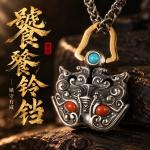
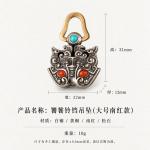
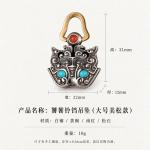
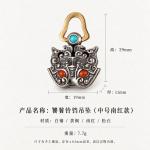
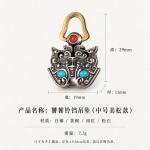
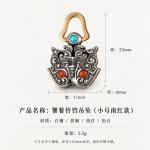
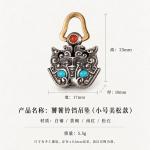
The body of the bell is a beast's face: two horns curving outward, round staring eyes, a nose at the centre, and a mouth stretched to both sides showing a row of teeth. A ridge runs down each side of the face from the root of the horn to the rim of the bell. The rim is round and its edge thickened to take knocks. A loop at the top carries the cord. The centre line of the face is a groove running from the bridge of the nose to the rim, with the two sides symmetrical.
This face is the taotie motif, common on Shang and Zhou bronzes: symmetrical, a head without a body, the eyes larger than anything else and the rest of the design converging on them. The name taotie was given by later ages; Song antiquarians compiling their catalogues settled it after the account in the Lüshi Chunqiu of a Zhou ding bearing taotie, and what the Shang themselves called it is not known. Taotie eyes usually use the chen-shaped eye, with a square socket and drooping corners, so that the face seems to glare.
The bell is hollow and holds a small pellet that rings when it is shaken. The note is not bright; it has a dull edge to it because the wall is not thin. Hung on a bag it sounds with every step, keeping time with the pace. On a mala it rings at every movement of the wrist, which will bother whoever is sitting beside you while you write. The pellet is small and strikes quickly, so the sound comes as a run of short notes rather than one sustained tone.
Six styles are offered in three sizes, each with either American turquoise or South Red agate. The turquoise pieces run blue-green and the South Red ones red, and the two colour families give the same face two different tempers. The large size suits a bag and gives a deeper note; the small size suits a mala and takes up no room. The smaller the size, the more detail is left out: the teeth and horns remain, and whiskers and the like are simplified away. The bead is round and sits between bell and cord, so the knot does not grind against the loop.
The inside of the rim is where the sound comes out and also where dust gets in. Over time a film of fine dust collects and the note goes dull. The top loop can be unscrewed and the bell tipped out, but do not rinse it with water, which dries slowly inside and turns the copper green. The eye sockets are deep and no cloth reaches them, so use air. The bead is stone and will chip, so keep it away from hard objects. The loop is the thinnest part, and a cord pulling at one point will wear it thin.