


Menu
By theme
By theme





{{ variable.name }} : {{ variable.values[selectedVariantsIndex[variable_index]].name }}
Quantity:
Halfway through stringing a strand, something always feels missing, and what is missing is usually the spacer. Spacers are the punctuation of a strand. Line up bead after bead of the same material and the color and grain run so close together that the eye goes flat; tuck a few pieces of another material between them and the strand finds its paragraphs, with a front and a back that can be told apart. A spacer never takes the leading position, yet it is the cheapest place to change the style. The same beads with different spacers amount to a different strand. On a bracelet the spacers sit between the main beads, one or a pair, and they do not count toward the total number of beads.
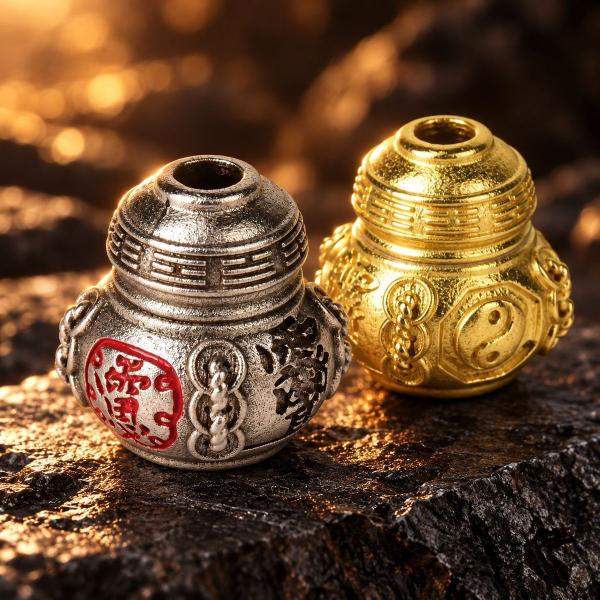
The gourd is an old symbol in folk practice. It sounds like the words for fortune and emolument, the vine sets a lot of fruit and a lot of seed, and in New Year prints it is drawn as two bellies, one large and one small. What Daoism values is its capacity for holding things: medicine goes inside, the mouth is small and the belly wide, and once stoppered tight nothing leaks out. The totem referred to here is the ring of pattern that travels around the gourd on the face of the piece, not a realistic drawing of a vine. Gourd vines in painting are always tangled, and the more tangled they get, the more solid the thing looks.
Copper dislikes sweat, summer most of all. Sweat sits inside the bore with no way out and gradually turns green. That is copper verdigris; it cannot be wiped away, only prevented. After wearing, press both ends with a dry cloth and tap the piece twice with the hole facing down to knock the dust out. Pad the surface with cloth while tapping, because a rim knocked out of shape will not let the cord slide. In the box, bag the spacers on their own. Copper against copper knocks out pockmarks.
White copper and brass sit far apart in tone. White copper is cool and clean, and against dark beads it lifts the whole strand; brass is warm and gets along with old material, coconut shell and the like, without a fight. The surface is finished matte, so it throws no hard glare, and up close there are fine grinding marks. Those come from the process, not from a fault. Both ends of the bore are rounded off, so the cord turns without chafing. A matte face barely shows fingerprints, which is one less thing to worry about than a polished one.
Spacers normally go in pairs, one on the guru bead side, one opposite, symmetric so the strand does not pull crooked. Some people add a single one on one side only, for asymmetry, but that depends on whether the main beads are plain enough; beads with a lot of pattern cannot carry the trick. With a thick cord, pick a spacer with a larger bore, because cord jammed into the hole makes the strand stiff. A pair should match in color and run against the color of the main beads, one dark and one light, and only then does the layering show. One white and one brass in the middle simply looks like a bead went missing.