


Menu
By theme
By theme




{{ variable.name }} : {{ variable.values[selectedVariantsIndex[variable_index]].name }}
Quantity:
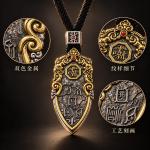
The True Form diagram of the Five Peaks is not a map. It compresses the shape of five mountains into a few curved lines, one cluster for each peak, the strokes winding around themselves in something that resembles seal script without being seal script. Daoists treat it as a talisman diagram and hold that carrying it into the mountains makes whatever lives there give way. The Baopuzi records the scroll and lists it among the things to carry when entering the mountains. The diagram was cut into stone and taken off in rubbings, and the lines of a rubbing vary in weight; carried over onto a copper plate, that variation has to be put back in with the graver.
The names of the five are not complicated: Mount Tai in the east, Mount Hua in the west, Mount Heng in the south, Mount Heng in the north, Mount Song in the center. One reading and they stay. The five peaks each guard one direction, and that scheme had already taken shape in the Han. The five directions pair with the five phases: east with wood, south with fire, west with metal, north with water, center with earth, and the set has to line up without a mistake. The five clusters on the diagram are arranged by direction, and the cluster in the middle is Song. Whether you can name them is not the point. What matters is whether the lines run unbroken, because the original lines connect, and a break scatters the whole figure.
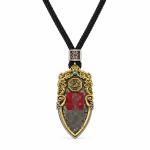
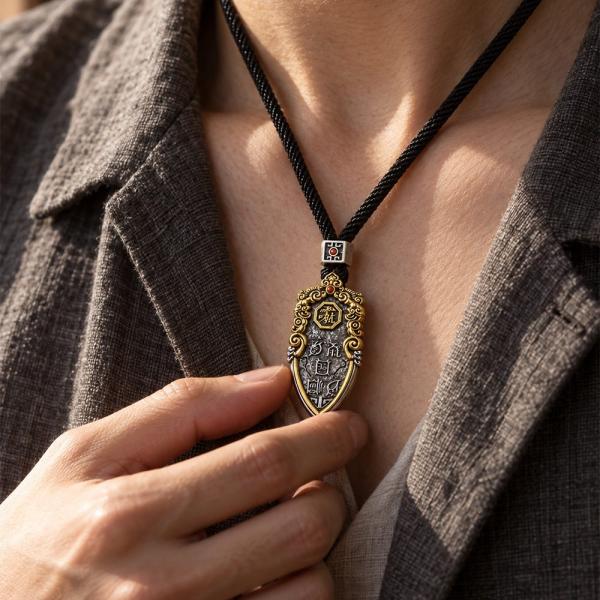
A white copper plate, engraved on one face. The lines are fine and cut shallow, and the result rests on how steadily the graver travels. Fine line work is ruined by a polishing wheel: one pass and the lines smear into a single patch. So the face is left matte, with only a light touch down either side of each line to let the line show itself. The back is plain and does not dig into skin. This kind of line is cut with a flat graver, one stroke to a line; stop halfway and a joint mark appears, and even an old hand does not want to go back and redo it.
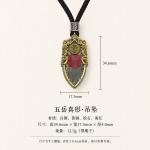
One standard size, sold as a single plaque. The Five Peaks diagram wants five mountains inside a square inch. Make the plaque larger and the space goes empty; make it smaller and the lines crowd each other. On a chain it faces outward, and as you walk it turns slightly, showing the blank back, which is clean in its own right. No chain comes with the single plaque, so the cord is your decision: a thick cord with a thick plaque, a fine cord with a thin one. Get the proportion wrong and it hangs awkwardly. The plaque is light, so do not overdo the chain; a heavy chain under a small plaque cannot hold the proportion.
Fine-line pieces should not be wiped every day. Each wipe takes a layer off the lines, and after ten of them the lines are flat. Press with a dry cloth in ordinary care, and do not rub back and forth along the lines; wipe across them and the dust comes out. If a scratch does appear, keep the sandpaper away. A fine oilstone, worked lightly along the line, if you have one; if not, leave it alone. Do not carry a fine-line plaque in the same pocket as your keys.