


Menu
By theme
By theme



{{ variable.name }} : {{ variable.values[selectedVariantsIndex[variable_index]].name }}
Quantity:
On a court necklace, the piece hanging at the back is the one most easily overlooked. That is the back-cloud, and it sits at the nape of the neck. The court necklace was a formal accessory of the Qing, a strand of one hundred and eight beads with a larger bead added at intervals, the Buddha head at the front, and the piece hanging down at the back is the back-cloud. Its job is to weight the center of gravity so the strand does not run forward. Later, bracelets borrowed the position, hanging a piece under the Buddha head as a pendant, though the old court-necklace rules no longer applied. The cloud in the name is the shape: old examples are mostly cloud heads or ruyi heads.
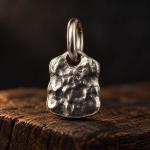
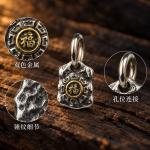
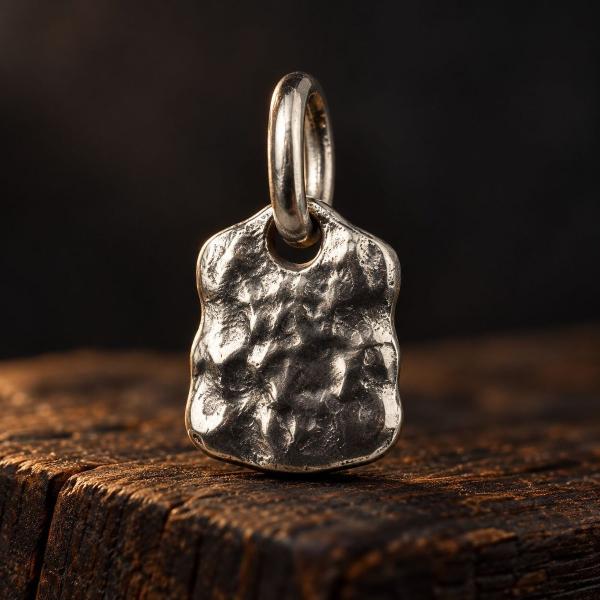
Hammered texture is struck blow by blow. The plate goes on an anvil and a small hammer taps it densely, leaving the surface covered in shallow pits, pit against pit, so that light falling on it breaks into many small pieces. Machine-pressed texture is even and looks false at a glance. Hand-struck pits differ in size and in depth, and that very unevenness is what makes it good. Chasing is an old craft; Tang gold and silver work was largely raised by hammering, and the texture began as a by-product of the process before it became decoration in its own right.
The pits of a hammered surface collect dust. Dust sitting in the pits turns the pattern grey, so dry-brush it with a soft brush in one direction and do not rub back and forth. Copper going dark is normal. To brighten it, press with a cloth rather than using polishing paste, because paste fills the pits and leaves a chalky white mess. Green rub-off stains light clothing and will not wash out, so be careful with a white shirt. Store copper pieces separately from silver, since two metals in contact will stain each other.
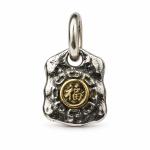
A fu character sits in the middle, its strokes thick, pressed onto the hammered field. After the character is cut, a little black is filled in so the edges do not fuzz; from a distance it reads as one dark block, and only up close do the strokes come apart. A fu written too full feels stifling, so a margin is left here, a ring of blank space between the character and the hammered texture, and only then does the eye have room to breathe. The back is flat and does not snag thread, a detail that matters more than how the front looks.
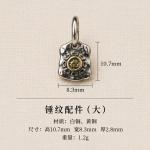
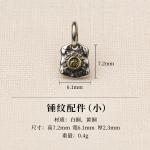
Two sizes. The large one suits a back-cloud, hanging at the nape with enough weight to hold the center of the strand; the small one serves as a spacer or a pendant, and its position is flexible. Which to take depends on the length of the strand and the thickness of the beads. Large beads take a large piece; the reverse and the strand goes top-light and bottom-heavy. Each size has its own use, so do not reach for the big one out of greed: an oversized back-cloud pushes the whole nape area out.