


Menu
By theme
By theme






{{ variable.name }} : {{ variable.values[selectedVariantsIndex[variable_index]].name }}
Quantity:
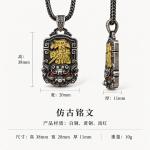
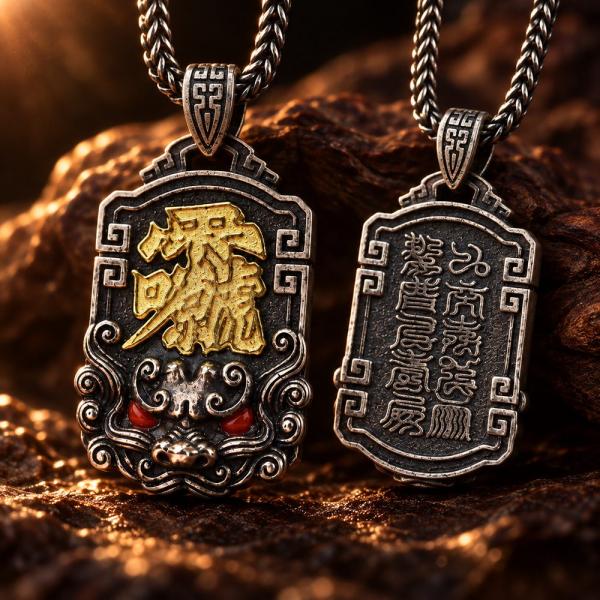
The square plaque is the hardest of the plaque forms. A round one is soft, a free-form one follows the material, but a square stands on four corners and hangs at the chest like a small stele. When a beast face is pressed onto a square, the proportion has to give way: the face takes the middle and blank space is left on the four sides. Leave too little and the piece stifles; leave too much and it goes empty. The corners are not true right angles but drawn in slightly, and drawn in too far the square turns into a round plaque.
The beast-face pattern comes from Shang and Zhou bronzes: two eyes, a single ridge of nose, horns curling to either side. Later generations moved it onto doors and called it a pushou, onto censer lids as a censer head, and onto plaques it is called simply the beast face. Its function has always been to guard, and it is placed wherever something needs blocking. The pushou with a ring in its mouth is the commonest form on a door, the ring there for knocking, and the type goes back to the Han.
The other face carries the Thunder Ancestor's taboo character. His full title runs to ten characters, and the taboo form compresses that title into one talismanic shape with the strokes stacked on each other. Daoist taboo writing follows rules about which stroke goes on top and which one closes the figure, and they cannot be shuffled about. The character on the plaque is cut deep with sharp walls to the cuts, and the layering shows under light. Every school writes it a little differently; shift a stroke and it is no longer the same character, so old plaques failing to match each other is a common thing.
Two configurations: the single plaque, and one with a Chopin chain. A Chopin chain is a close-linked chain, each link biting into the next, so it does not catch hair and does not break easily, which suits a pendant with the weight of a square plaque. Antique finish refers to how the cuts are treated: the aging is laid on heavy, as though the piece had come out of the ground. The links of a Chopin chain are round and bright, and set against a matte plaque the light and dark pairing looks better than a chain in the same finish. The plaque is thick enough to sit with weight in the hand.
Do not take a wet cloth to an aged piece. Water gets into the cuts and the color of the copper mottles. Press with a dry cloth, and use a soft brush in the seams. The corners of a square plaque are where knocks land first, so put it away separately instead of piling it into a box with other pieces. The dark of an aged finish will wear away, faster on the side against the skin than on the front, and that counts as normal wear. The clasp of a Chopin chain is a small spring clasp that loosens over years of use, and replacing it costs very little.