


Menu
By theme
By theme


{{ variable.name }} : {{ variable.values[selectedVariantsIndex[variable_index]].name }}
Quantity:
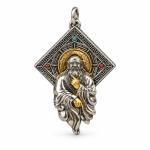
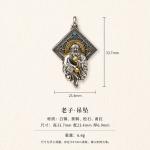
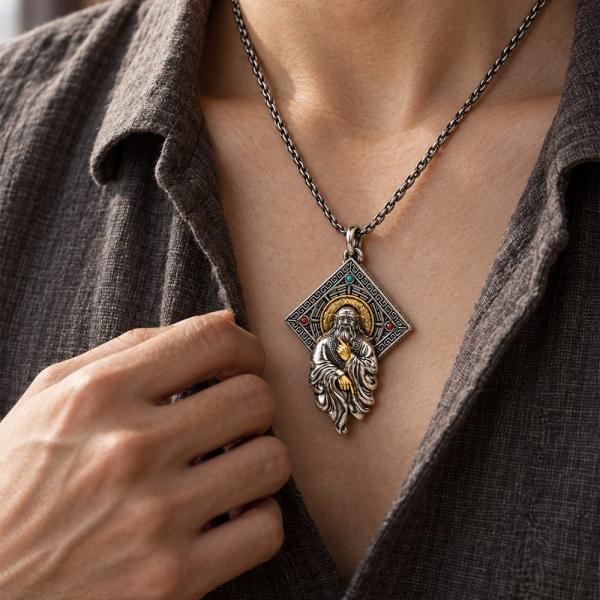
Laozi is a hard figure to make. He has no fixed divine persona, unlike Zhenwu with his turtle and snake or Wang Lingguan with his golden whip, and only two marks identify him: a long beard and a loose robe, sometimes a scroll in the hand. Daoism honors him as Taishang Laojun, but that is the deified form, one layer removed from the man who wrote five thousand characters and left it behind. In Han reliefs Laozi is a lean old man; by the Tang and Song the sculptures grow fuller in the body, and by the Ming and Qing they come back to the lean line. Beard length shifts with the dynasty, and a beard reaching the chest is the later convention.
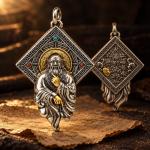
The bagua is a separate system. Fuxi is said to have drawn the trigrams, eight symbols paired with heaven and earth, water and fire, wind and thunder, mountain and marsh. Laozi with the bagua is a combination common from the Ming and Qing onward, joining two sources of Daoist thought on a single piece. The Book of Changes says that in the Yi there is the taiji, which gives rise to the two modes, and the eight trigrams divide down from the taiji. Set in a ring, whether qian sits in the south or the north depends on the earlier or the later heaven arrangement, and the order on a plaque has to match the one it claims.
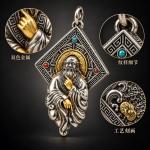
Round, with relief on one face. The hardest part of a figure in relief is the face: the eye sockets, the bridge of the nose and the cheekbones have to rise in exactly the right places, and a hair off makes it a different person. This face is kept simple, the features indicated with a few shallow lines, and the head is held up by the direction of the beard and the folds of the robe. The robe lines are pressed with a slanting graver so that each runs deep at one end and shallow at the other, and only then does it read as cloth. The hem is pressed low, and that is what settles the weight of the plaque.
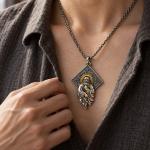
Single plaque, standard size. Portrait pendants follow one rule: the face goes outward and never against the skin. Copper against skin plus sweat goes green, and it is not comfortable either. Cord or chain both work; choose a dark cord so it does not compete with the figure. A coarse hemp cord suits this subject, while a fine chain makes the whole thing look slight. The chain version arrives with its chain and saves you the search, and the chain is fine, since the figure itself is light and a heavy chain would overpower it.
A figure has many recesses, and the beard lines are the finest of them, so dust settling there reads as dirt. Dry-brush with a soft brush and blow across the piece once afterwards. Do not pick at it with a needle, because the tip will break a line and a broken line cannot be joined again. The face of a copper figure suffers most from touching: finger oil collects on the bridge of the nose and in the eye sockets, and after a year those two places go black. When you set it down, put it face up and do not let anything rest against the face.