


Menu
By theme
By theme





{{ variable.name }} : {{ variable.values[selectedVariantsIndex[variable_index]].name }}
Quantity:
A keyring is a working object, ground against keys in a pocket every day. Its life is not decided by the pattern but by two points: whether the opening of the split ring loosens, and whether the connection holds. Pass those two and only then does the question of looks come up. The simpler the structure, the longer it lasts, because more parts means more ways to fail. The wire of the split ring should be bent from a single piece rather than joined from two, since a joined one opens within six months. Keep three keys on it at most. More than that and the load on the ring runs uneven and it bends.
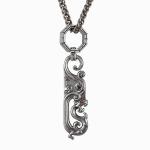
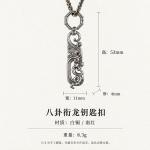
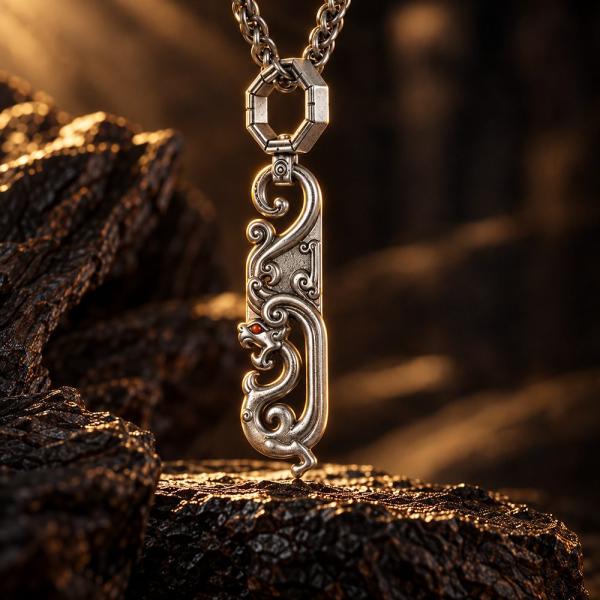
The form is a bagua ring with a dragon biting into it. The eight symbols are cut on the face of the ring, and a gap is left on the inner side; the dragon's head comes in through the gap and grips the body of the ring, while the tail wraps around behind and closes it off, so that from the back it is one complete dragon. This gripping structure is common in old silverwork: one object in two parts, held together by the bite, with no solder anywhere. The gap has to leave enough clearance for the dragon's head to pass, and too little means it will not go together at all.
Two versions, the single clip and one with a chain. The single clip holds keys; the chained one can hang at the neck as a pendant or be clipped to a bag. One piece doing the work of two is why I was willing to stock it in the first place. Used as a pendant, the chain goes through the hole in the dragon's tail and not around the bagua ring, where the balance would be wrong. On a bag, clip it to the zipper pull rather than to a fabric loop, because the fabric will wear through.
White copper. It is hard, and for a load-bearing structure like this bite joint it stands up better than pure copper. The finish is aged, the bagua symbols sunk and the dragon scales raised, so light and dark sit together: from a distance one mass, up close the layers separate. It is hard enough, but the bite joint concentrates stress, and a single drop can knock it out of alignment, so when you pick it up, check that the mouth still holds. Dust in the joint makes it stiff to turn, and a toothbrush takes care of that.
Wear concentrates at the ring. You can see it from the side: once the wire has thinned all the way around, replace it instead of making do, because a set of keys dropped in the street is not easy to find again. Change the pin along with the ring. Replace the ring alone and the old pin stays, and it will not last. When the copper dulls, press it with a cloth, and take the dust out of the seams with an old toothbrush, dry. Copper needs no oil; oil only makes the dust stick.