


Menu
By theme
By theme



{{ variable.name }} : {{ variable.values[selectedVariantsIndex[variable_index]].name }}
Quantity:
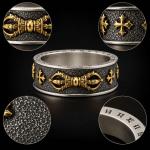
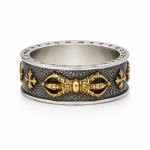
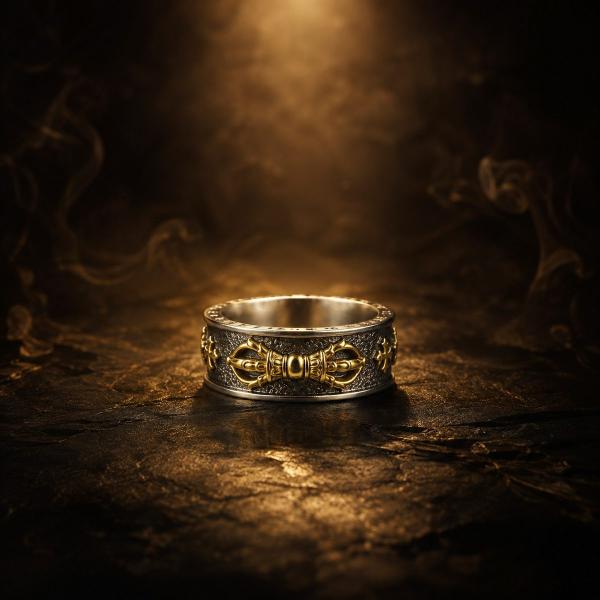
Turning a vajra into a ring begins with changing its shape. A vajra as it stands is fat at both ends and narrow in the middle, which would catch on clothing and sit badly on a finger, so a ring usually takes only the central section, flattens the prongs and runs them round the band. It still reads as a vajra, but it has been taken apart, compromised and re-laid. Done well, you can still name it from across a room; done badly, it is a band of pattern and nothing more.
The vajra's origin is not mysterious. It began as an ancient Indian weapon, something thrown that could shatter what it struck, and was later taken up by Buddhism as a symbol of the dharma, indestructible and unbreakable. In Chinese it is chu, in Tibetan dorje, and the form comes in single, three and five-pronged versions. The more prongs, the denser the detail, and the harder it is to render clearly at small scale. A ring band is narrow, so a five-pronged vajra usually has to be simplified. That is not cutting corners; it is making room.
Manjushri and the vajra are not a fixed pairing. Manjushri's attributes are the sword and the book: the sword cuts through affliction, the book stands for wisdom, while the vajra is a general ritual language rather than a personal emblem. Putting the two together on one ring sets a wisdom subject beside a ritual form, a combination common enough in folk jewellery. Some people mind the mismatch and some only look at whether it works. Knowing this much, a seller should not invent a story to bridge the gap.
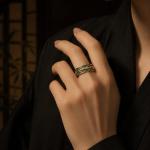
The open structure is genuinely useful. A gap in the band lets it be eased wider, which deals with knuckles and with fingers that swell in summer. But white copper is hard, and repeated wide bending will fatigue it, so adjust it once and properly rather than playing with it like a clasp. It sits more securely on the index or middle finger than the ring finger; the shank is wide, and a very slender finger cannot carry it. Run a fingertip round the cut ends and file any burr before you wear it.
The vintage surface is on the dark side, which hides scratches, and that is an advantage. The drawback is that it catches on the desk when you are typing or lifting, and a day in the office will leave marks. Take it off to wash your hands or apply hand cream; residue lodges in the grooves between the prongs, darkens over time and is fiddly to clean out. If you are sensitive to nickel, remember that a ring sits directly on skin, and in summer watch for redness at the base of the finger. Whether the inside of the band has been rounded off is not something a photograph can tell you, so feel for it when the ring arrives.