


Menu
By theme
By theme

{{ variable.name }} : {{ variable.values[selectedVariantsIndex[variable_index]].name }}
Quantity:
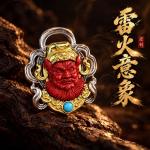
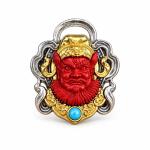
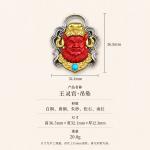
Wang Lingguan is the door god of a Daoist temple. The first hall inside the gate is the Lingguan Hall, and he is what it enshrines: red face, three eyes, curly beard, golden armor, a golden whip raised in one hand. The image stands with one foot thrust forward, and that stance is there to block, not to welcome. Among the guardian deities of Daoism he stands furthest out and is the one most often seen. His office is inspection, and anyone who behaves badly inside the hall answers to him. A couplet often hangs at the door of the Lingguan Hall: three eyes that see all things under heaven, one whip that wakes the people of the world.
Legend gives his original name as Wang Shan, a fierce deity from the Xiangyin region, later taken as a subordinate by the Celestial Master Sa Shoujian and turned from his old ways. Sa Shoujian was a Daoist of the Song known for thunder rites, and the story of the subduing is recorded in the Sancheng Yuanliu Soushen Daquan. Ming popular fiction tells it in more detail. True or not, temple images have followed that mold ever since. A red face in opera signals loyalty and straight dealing, and the sculptures are painted to match, so he looks fierce while standing on the right side.
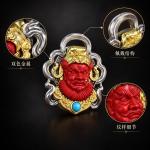
A figure in relief on a tall rectangle. A vertical plaque suits a standing figure, with the pose filling it from head to foot, the plates of the armor layered one over another, and the whip raised on the diagonal above the head to fill the space at the top. What ruins a standing figure is a large head on a short body, and once the proportion goes the whole piece goes with it. A vertical plaque is full from top to bottom, so the hanging hole has to sit high; set low, the whole plaque tips forward. The whip is bent in one continuous run and the tip is thin, the part most likely to break in casting, so that is the first place to look.
The grooves between the armor plates are deep, and dust sits in them where you cannot see it until you touch it. Brush with a soft brush along the direction of the plates, not across them. Do not take a wet cloth to an aged surface; water gets into the grooves and the color mottles. Wipe sweat off the copper on the spot instead of letting it dry, because dried sweat leaves a dark patch. In a pocket, turn the plaque inward so the tip of the whip is not pressing against the cloth.
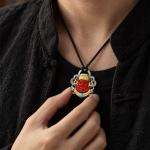
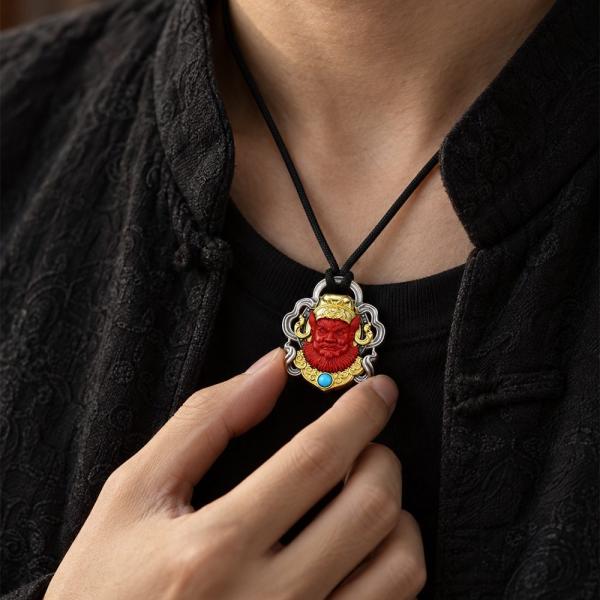
Single plaque or with a chain. The single one takes a cord of your own, and the chain version saves the trouble. It hangs at the chest with the vertical plaque against the breastbone, and the lower end taps lightly as you walk, making a faint sound. The golden armor is pressed as one piece, plate over plate from the chest down to the knee, and that is where the work is spent. The gaps between the plates are cut deep so that light casts shadows there and the thickness reads from a distance. On the chain version, pick a medium-weight chain, because a fine one cannot hold up a vertical plaque.