


Menu
By theme
By theme


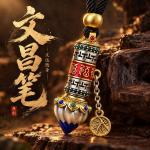

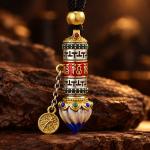
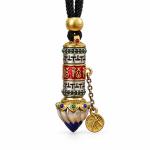
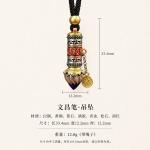
{{ variable.name }} : {{ variable.values[selectedVariantsIndex[variable_index]].name }}
Quantity:
Wenchang Dijun governs literary fortune. His origins are complicated: he began as a local god in the Zitong area of Sichuan with charge of the floods in Shu, and after several rounds of imperial titles through the Song and Yuan he became a deity of the whole country, and once the examinations took hold, more people came to him. His marks are the brush and the dou measure, the brush for literary fortune and the dou for weighing talent. His birthday falls on the third day of the second month, and the old academies held rites on that day. Scholars made offerings to Wenchang, and what they were offering was the hope they carried.
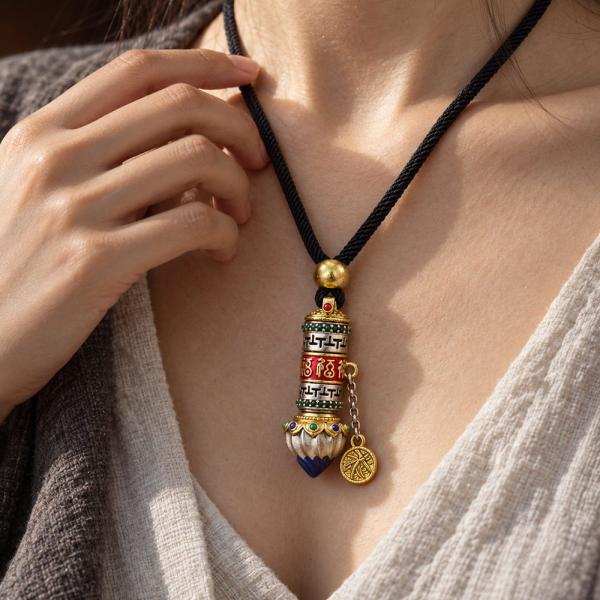
This brush is made as a cylinder, thick at one end and tapering at the other, with the thick end standing for the brush socket and the thin end closing into a tip. The tip is not sharp but rounded off, so it does not stab when worn, a point that small-piece makers often overlook. A fu character is cut on the shaft, pressed onto the curved surface so that it joins up as it comes around. The socket is the end a brush would go into, and as a cylinder it makes a natural place to gather the cord, with the bore hidden in the top of the socket where it cannot be seen.
A cylinder pendant carries its center of gravity in the middle, so hung it wants to lie sideways, which makes the position of the hole critical. The hole belongs at the top of the socket so that the cord leaves along the axis and the piece hangs vertical. Pieces that get this wrong always hang crooked. Set the hole a little off and the brush hangs at a slant, barely noticeable to look at and awkward to wear. The cord should come out of the hole straight, because any slant shows.
These are mostly bought for examination candidates, and for people just starting a job. The brush image is plain and needs no explaining. It does not look out of place from day to day: the cylinder is simple and works with a shirt or a sweater, though it should not be crowded in with a bunch of jingling charms. A candidate wears the brush for the idea of a spirit in the brush, a saying found in every region with no clear origin. The shaft is slim and sits right between the fingers, and any thicker it would turn clumsy. The word for brush sounds close to the word for certainty, and giving a brush once carried a pun about certain success.
The surface is curved, so wipe around it with a soft cloth rather than straight back and forth. Dust collects in the strokes of the fu character, so sweep it out with the tip of a soft brush and not with a toothpick. If the cuts get wet, dry them at once and do not let water stand inside the character. A sweater will catch on the edge of the fu, so tuck the pendant inside the collar when wearing a coarse knit. Store it in a soft cloth bag and keep it away from keys.