


Menu
By theme
By theme






{{ variable.name }} : {{ variable.values[selectedVariantsIndex[variable_index]].name }}
Quantity:
The six lines are the skeleton of the Yi. A hexagram is six strokes, a yang line one long bar and a yin line two short ones, stacked from the bottom upward; six strokes fix a hexagram, and that is where the sixty-four come from. The rule of divination is to have the hexagram first and then look at the moving lines, reading the direction of the matter in the space between what moves and what stays still. The six in six lines refers to six positions, from the first to the top, and a different position means a different judgment of fortune. When a reading is done, one moving line is the common case and two or three are rare. The names of the sixty-four, Qian, Kun, Zhun, Meng, run one character to a name and one meaning to a character.
The plaque lays out the six lines as two trigrams, upper and lower, with a horizontal line between them dividing inner from outer. That arrangement follows the later heaven bagua, where the earlier heaven deals in opposition and the later heaven in sequence. Makers often cut all the lines to the same weight, but there should be a difference here: a yang line is whole, a yin line broken, and the break needs a little space in it or the two cannot be told apart. Nor can the gap in a yin line run too wide, or it reads as two yang lines. A yang line goes in one stroke from end to end, and broken in the middle it becomes yin.
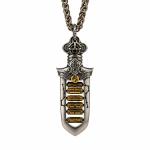
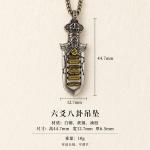
White copper, one face. The lines are engraved, the floor of each cut darkened, the face polished, so that under light six lines float on the surface of the plaque. The back is plain except for a workshop mark, a habit found on old pieces as well, and reading marks is a study of its own. The plaque is rectangular with rounded corners and the hanging hole at the center. It is long enough for six strokes; a shorter plaque cannot lay them out and has to compress them, and compressed they crowd.
Engraved lines are fine, and dust that goes in does not come out, so the lines turn grey over time. Dry-brush with a soft brush along the direction of the lines. Do not use an ultrasonic cleaner: the vibration is too strong and the matte surface mottles. The face is polished, so fingerprints show plainly on it, and it should be wiped with a soft cloth rather than a tissue. No toothpaste either, since the grit is coarse and leaves a haze on a polished face.
Hung at the chest, the direction of the lines must not be reversed: they are read from the bottom up, with the first line at the bottom. If the plaque does not mark top and bottom, remember it yourself when you string it, because hung the wrong way around it reads as a different hexagram. This is not mysticism, it is how the thing is read. Choose a dark cord, since a weaker contrast against the lines actually makes them clearer. Do not tie a hard knot when stringing; the plaque is light and a large knot pushes it out from the chest.