


Menu
By theme
By theme



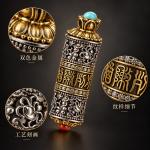

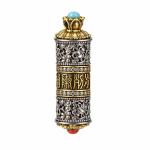
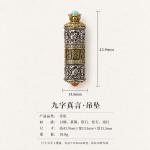
{{ variable.name }} : {{ variable.values[selectedVariantsIndex[variable_index]].name }}
Quantity:
Openwork is most often seen on jade plaques of the Qing; on copper it came later, and it depends on wire-cutting and files. Openwork means taking away everything that is not a stroke and leaving the strokes alone. The gain is that light passes through: worn on the body, the color of the clothing underneath shows through the gaps in the characters, and the characters read more clearly for it. The cost is fragility, because thin one stroke and a knock will break it. The proportion of what is removed matters: leave too much and it is not open, take too much and it breaks, so before starting you have to work out which strokes can be spared.
The nine characters run in a ring, or vertically, end to end, and the stroke where the last meets the first has to be broken, or there is no telling where the reading begins. The characters are a mantra, and how it is recited is another matter. After the esoteric tradition came in, these nine were fitted into the nine-assembly mandala, one character to one deity, an elaborate scheme, and folk practice takes only the sense of blocking. A thin line joins character to character, or the nine would come apart into a heap of separate pieces.
White copper sheet, cut first and pierced afterward. The cut edges have to be dressed or they scratch the hand. On this piece the edges of the characters are rounded and do not cut, which says the dressing was done properly. The sheen of openwork lives at the edge: once the sides of the cuts are polished, the face gains depth. Filing comes first and polishing after, and where the wheel cannot reach, the work is done with cord pulled back and forth, since narrow places will not take force. The cuts should be consistent in width, because uneven width shows the moment light falls on it. The sheet is thin and thinner still once pierced, so support it when you pick it up.
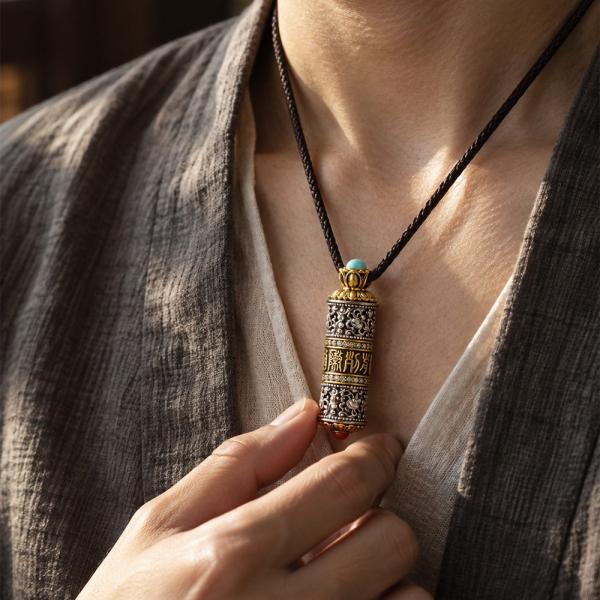
It is light and does not drag at the neck. Openwork should not be layered with other pendants, since crowded together one knock deforms it; if you must layer, put it on the outside. It goes best with plain clothing, a white shirt or a grey sweater, where the color coming through the gaps stays clean. A light piece creeps upward over time, so the cord needs a knot that slides.
If it deforms, do not bend it back yourself. Copper work-hardens, and bending it back once leaves that spot soft, so it bends there again the next time. If it really does deform, take it to someone who makes jewelry and let them tap it back with a mallet. Store it on its own rather than in a pile with hard objects, and put it between two sheets of soft paper instead of letting it tangle with a chain, because pulling a tangle apart can snap a stroke. No ultrasonic cleaning for openwork: the vibration is too strong and the thin strokes crack.