


Menu
By theme
By theme



{{ variable.name }} : {{ variable.values[selectedVariantsIndex[variable_index]].name }}
Quantity:
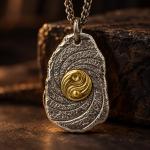
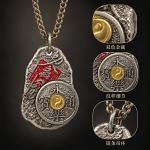
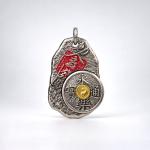
A spinning pendant is built in two layers. The outer ring is fixed, the inner plate turns, and a pin runs through the middle of both. Old silverwork uses this structure and calls it a turning heart: the plate inside turns and the design changes piece by piece. The workmanship demands a true pin, because off by a little and it wobbles as it turns. The gap between the layers has to be just right as well: too tight and it will not turn, too loose and it wobbles badly, and it is set by feel. The outer ring and the inner plate are not the same surface, one polished and one matte, so the turning gives a contrast.
The form comes from the square-holed coin. Round outside and square inside, that form ran from the Qin banliang to the end of the Qing, two thousand years with little change. The characters on a coin are usually four, set around the square hole, read either straight through or spiraling. The four are mostly a reign title plus the words circulating treasure; charm coins carry no reign title and give auspicious phrases instead. The square hole sits dead center, and off center the coin is no longer round. The hole was there to string coins one to the next, and an off-center hole makes a stack sit uneven.
The characters are in relief, standing above the face, with real height under the finger. Relief characters are harder to make than engraved ones because they have to rise, and the sides of the strokes have to be worked as well, or light hits them as a dead edge. Here the sides of the cuts are slanted, so light coming down from above leaves one side of a stroke bright and the other dark, and the character stands up. The characters have to stand a hair above the face and there must be metal beneath them; too thin and they cannot rise at all.
Do not drip oil into the pin. Oil attracts dust and the turning only gets stiffer. If it truly needs cleaning, wipe it with a dry cotton swab, or have a jeweler take it apart. Dust inside a turning heart makes a sandy sound as it turns, and a puff of air is enough to clear it. The circle around the pin is the most easily overlooked spot, so run the cloth over it while you are there. Press the copper with a cloth and do not poke at the inner plate; the high points of the relief should not be pressed hard, because once worn flat the characters go blunt.
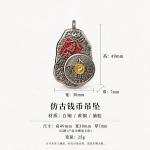
Two versions, the single plaque and one with a Chopin chain. The Chopin is a close-linked chain and holds a pendant with this much thickness to it. Chain length follows where you want the piece to sit: out over a sweater means longer. The chain passes through the hole in the outer ring, so the inner plate carries no load and the pin takes only the force of turning, not of pulling. Close links do not catch hair and will not snag a high collar in winter. The clasp has to open and close, and a close-link clasp is small, which is hard on anyone with short nails.