


Menu
By theme
By theme

{{ variable.name }} : {{ variable.values[selectedVariantsIndex[variable_index]].name }}
Quantity:
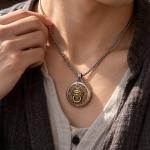
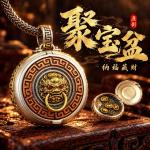
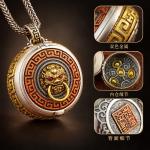
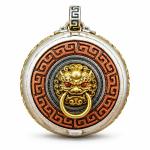
The mouth of the basin flares, the belly swells, and the base draws in to a ring foot. Inside sits a heap of ingots and square-holed coins, and a small beast sprawls over the rim — this is exactly how the treasure basin is drawn in New Year prints. The pendant flattens the whole vessel into a plaque: relief on the front, the beast moved to one side of the rim, body curled, head turned outward, four paws clamped over the edge. The thickness sits in the belly, so it carries a little weight on the chest and does not float. The tail drops behind the rim and presses into the key-fret band.
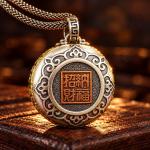
Key fret is a line folded into square corners, ring inside ring, ends joined into a road that never stops. Square-cornered thunder patterns appear on Shang and Zhou bronzes; later, brocade, lattice doors and furniture aprons used the same border. The folk name for it is blunt — wealth that never breaks off — because the line never touches ground. Carved on the belly, it says what the basin's name says: one asks for fullness, the other for continuity. Every corner of the fret is a right angle; nothing turns softly.
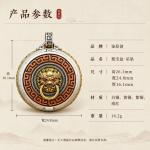
White copper (cupronickel) reads cool rather than yellow, and the steps of the relief show clearly in raking light. The belly is not raised high; the bulges are pressed flat, so a fingertip finds the contours without snagging a sweater thread. The rim is rounded over, the beast's ears and claw tips are blunted, and nothing on the front will scratch. The back is one flat plane with a cord hole through the middle, the mouth of the hole chamfered so the cord cannot wear itself through. The fullest point of the belly sits below center, where light lands as a small bright patch.
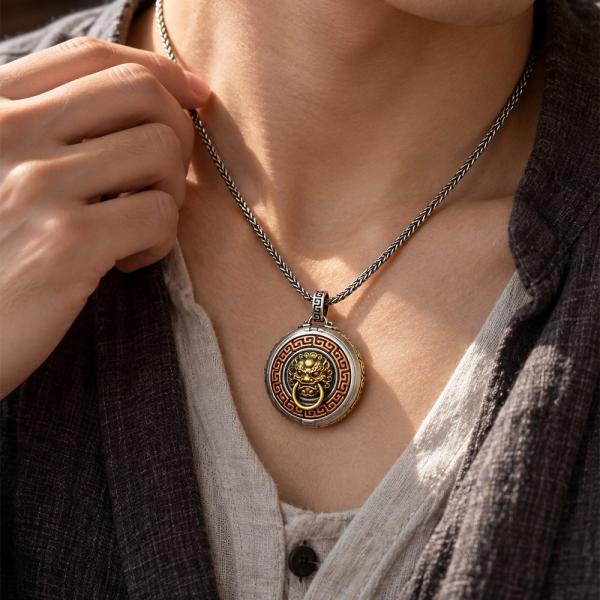
The pendant on its own is the biggest seller; most buyers already own a chain and swap it over at home. The Chopin chain version is a complete chain, flat links that hang without twisting, clasp at the back — you have to feel for it twice to fasten it yourself. The cloud cord is braided, deep in color, and adjusts by pulling; it sits against the neck and does not slip when you sweat in summer. Of the three, the cord sits closest to the skin and the chain is the least fuss. The pendant alone is just the plaque; cord and chain are yours to choose.
Relief work dislikes knocks. The rim and the beast's head take the first damage, and a small dent in a bright surface cannot be polished back. Store it in its own pouch, not loose in a pocket with keys and coins. Copper left alone gathers a dull film; press it evenly with a dry cloth rather than scrubbing at it with a wet wipe. If you want it bright, sweep a silver cloth lightly over the raised areas and leave the recesses dark — that contrast is what holds the form. Seal the cloth after use; left open to the air, it dries out.