


Menu
By theme
By theme

{{ variable.name }} : {{ variable.values[selectedVariantsIndex[variable_index]].name }}
Quantity:
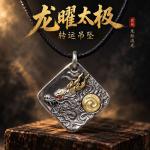
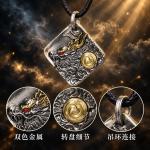
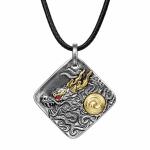
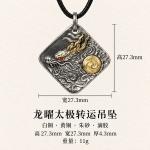
A dragon coils into a ring around a taiji, then turns its head back until it is almost biting its own tail. The composition is not new. Han jade discs already set a dragon around the central hole, though what filled the middle then was usually a grain or rush pattern, not necessarily a taiji. Here the two are forced together and, on the whole, sit well: the taiji holds the center, the body wraps nearly twice around it, and the tail tip tucks under the jaw.
The word taiji comes from the Commentary on the Changes: in change there is the Supreme Ultimate, which gives rise to the two modes. The diagram came later. The familiar pair of fish, head to tail, a dot of black in the white and white in the black, is generally dated late by scholars and only spread widely in the Ming and Qing. Word first, picture more than a thousand years afterward — many people take it for an ancient diagram, and that is a misunderstanding. The Commentary explains a text; it is not a pattern book.
The body is cut in three sections. Exposed scales run in diagonal rows, tightening toward the tail and thinning out at the head, where only a few ridge lines remain. The claws are not sharpened; they grip the edge of the taiji, four toes pressed into the belly of the yin fish, placed precisely — shift them a little and the dragon would be standing on air. The whiskers are two fine lines laid flat on the plaque, not projecting past the edge. Scales are cut with a slanting chisel, each overlapping the next, all in one direction.
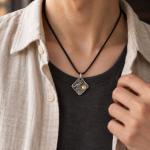
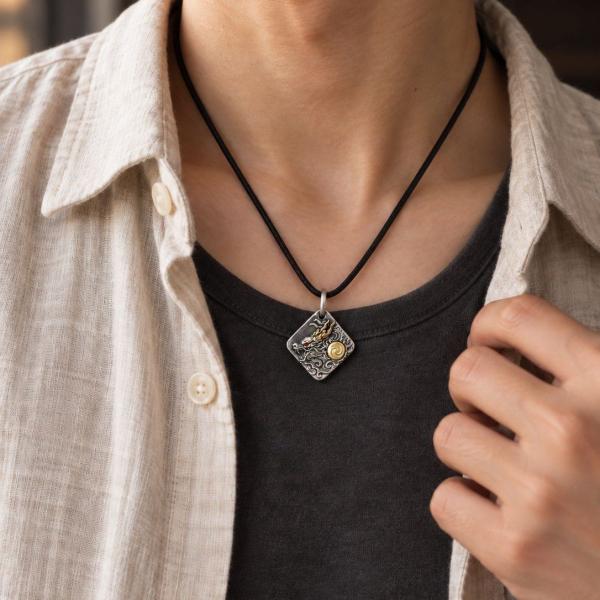
The plaque is round, the front slightly domed, the edge raised into a narrow ridge that the finger reads as a clear boundary. The back is ground flat, and the hole sits at the upper edge, set back, so the face turns outward on the cord instead of flipping against your clothes. A round plaque lies on the chest and barely swings when you walk; running gives it two soft taps. The ridge is narrow — its job is to contain the shape so the edge does not look thin.
There is one version only, so there is nothing to choose between in the options. Cord or chain comes down to habit: a thick cord carries the weight, a thin one is lighter, and a short cord suits a lower collar. White copper darkens quickly on anyone who sweats freely; once summer passes, a film forms and a dry cloth wiped along the ridge evens it out. Do not dig at the yin eye of the taiji with a fingernail — it is the shallowest point on the face, and a scratch shows immediately. Cord frays in time; cut a fresh length and re-knot it.