


Menu
By theme
By theme

{{ variable.name }} : {{ variable.values[selectedVariantsIndex[variable_index]].name }}
Quantity:
A hand gesture is what the fingers do in ritual: how they cross, how they hook, which ones stay straight. Lineages differ, and the same name can be done differently from one place to the next. The Lingguan gesture is one of them, addressed to Wang Lingguan. Made into a pendant, what is taken is the outline of the gesture — not something for anyone to copy and learn from, and not worn as a protective device. Gestures are not taught publicly; a drawing is only a shape, and the real method requires a teacher.
Wang Lingguan is a guardian deity in Daoism. His images are usually red-faced and three-eyed, in armour, with a whip in his hand. Enter a Daoist temple and the first courtyard often houses him, centred and facing the gate. Folk memory of him is more concrete than of many higher gods, because the image stands right at the door: you see it first, and you remember it. Legend gives him the name Wang Shan, a local god who later came in through the temple gate.
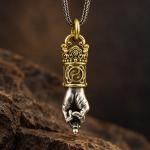
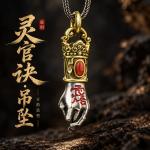
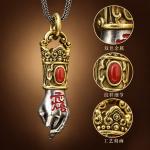
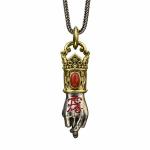
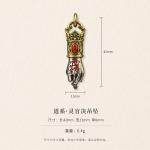
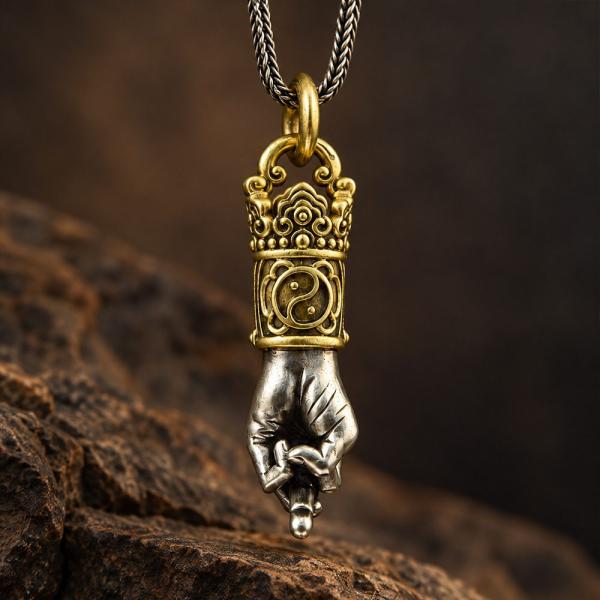
The pendant presses the shape of the hand into a plaque. The knuckles swell section by section, the gaps between the fingers are hollows, and the antiquing keeps those hollows dark while the raised knuckles are polished bright. In profile the relief is modest, thickest at the base of the palm. The back is flat and comfortable against the chest, the chamfer at the rim is wide, and the cord hole is drilled at the wrist, so the hand hangs the right way up once the cord is through. The grooves between the fingers run deeper than the knuckles, and the dark of the finish gathers there.
Antiquing is not the same thing as dirtying. What stays in the hollows is oxidation, the highs are brought back to bare copper, and the edges take a little extra brightness; the three layers together make the age. Some antiquing on the market is a wipe of black lacquer that leaves the whole piece sooty, and two days of wear takes the lacquer off in patches — cheap, but it doesn't survive a close look. Depth of antiquing can't be standardized; two plaques from the same batch will differ in tone, and that variation belongs to the process rather than being a defect.
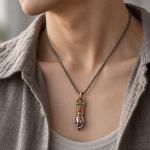
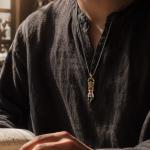
Two options: the pendant alone, or with a necklace. The necklace version pairs a fine chain, the pendant sitting a little below the collarbone with the gesture facing out. White copper doesn't need frequent polishing; the more you polish it, the more the aged look goes. Fingerprints on the raised surfaces come off with a dry cloth — skip toothpaste, whose grit takes the antiqued layer with it. A very fine chain lets a heavy pendant flip over; this one isn't heavy, so it stays put and the gesture keeps facing out.