


Menu
By theme
By theme






{{ variable.name }} : {{ variable.values[selectedVariantsIndex[variable_index]].name }}
Quantity:
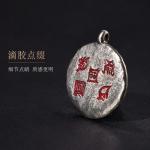
The Five Peaks is an old set of geographical names: Taishan in the east, Huashan in the west, Hengshan in the south, Hengshan in the north and Songshan at the centre. Daoism gathered the outlines of the five mountains into a single diagram, the True Form Chart of the Five Peaks, in which the shapes are compressed into curling symbols that look less like a map than like seal script. The amulet follows that approach, abstracting the mountains into lines, and the wearer need not be able to say which is which. The order of the five was adjusted under different dynasties; today the name means these five, and there is no need to open that up here.
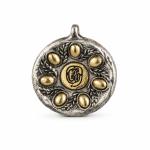
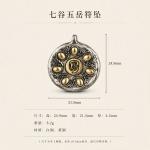
The seven grains are more various than the five grains. Different regions make up the number differently, some adding hemp, some sorghum, until seven are reached. On a pattern it is not worth insisting which seven: what you look at is whether the row is even in size and whether the spacing is consistent. Grain carved at uneven sizes scatters at a distance, and a small tag gives itself away here first. A hairline of space between the grains looks better than packing them tight.
With an amulet, check first whether the shape of the plate is true. The border line should be even and the hole should sit on the centre axis; off by a little and it hangs crooked, and crooked looks wrong from every angle. There should also be enough blank space, because a pattern that runs to the edge feels stifled. The border here is left reasonably wide, the front carries dense information and the back is kept clean, so turning it over does not feel hollow. Watch the thickness as well: too thin feels insubstantial, too thick presses on the neckline.
The aged layer is applied over the top, and the grooves of the mountain lines take the black first, which makes the lines clearer. That is the material doing some of the work. What still needs attention is hardness: white copper resists wear but not falls, and once the face takes a dent the aged layer is broken and cannot be restored. Choose a fine cord or chain, since the plate is small and a thick chain overwhelms it. Uneven depth in the ageing is a mark of handwork, and brightened corners are normal.
The options are the pendant alone or with a chain. If you already have a chain, buy the pendant and control the length yourself; if you would rather not bother, take the set and save yourself the trip. This one is fairly unisex, fine for an older relative or a friend in business, though for a younger person you should check whether they wear this sort of thing at all rather than pressing it on them. The chain should land a finger's width below the collarbone, which puts the pendant just above the chest. The corners of the plate should be rounded, because square corners will wear at clothing.