


Menu
By theme
By theme

{{ variable.name }} : {{ variable.values[selectedVariantsIndex[variable_index]].name }}
Quantity:
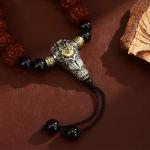
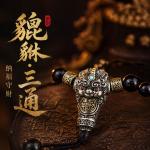
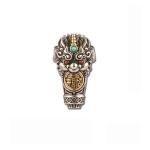
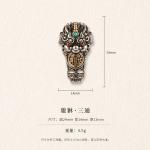
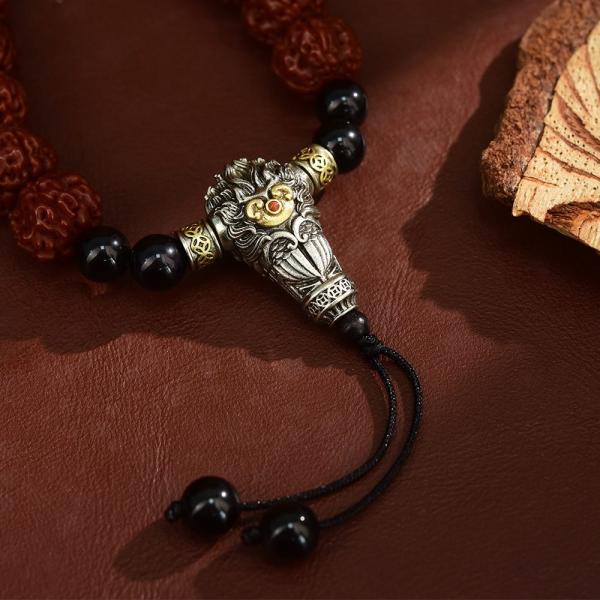
The three-hole bead is the piece that finishes a strand. It has three holes: two in line for the main cord, and a third running vertically, taking the cord out to the disciple beads or straight into a closing knot. It sits at the very end of the strand and is also its hinge — drill it slightly off and every bead after it runs at an angle, and the whole strand hangs wrong. Whether to hang disciple beads below is a matter of habit; with them you gain a short extra drop. The walls of the holes need thickness, because too thin a wall cracks under load.
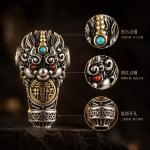
The turquoise is set in rather than glued on. Turquoise is soft, far softer than copper, so a seat is cut first with walls left at a slight taper, the stone is pressed in, and the edge is closed over it. Rush that closing and a chip comes off the stone, and a chip cannot be put back. Turquoise carries iron lines and ranges from blue to green; even one batch won't match itself. A deep seat holds the stone; a shallow one lets it go with wear. A properly set stone doesn't move — push it with a nail, and if it shifts, it isn't tight.
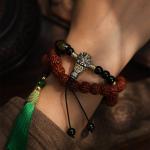
People who build their own strands use it as a finisher, and almost any bead can go in front of it. White copper doesn't fight color: southern red agate, amber and wood all sit well under it. With silver beads both end up looking grey, so put a dark bead in between instead. Before stringing, test the hole with a scrap of cord. Too thick and it won't pass, and forcing it lifts a burr at the mouth. Keep the companion beads from being much larger than the three-hole bead, or the strand turns top-heavy and pulls forward.
Turquoise fears sweat and oil, and worn long its color deepens. That is the stone's nature, not dirt. Take it off for showers and hand cream, because oil entering the pores mottles the surface. Wipe the copper with a dry cloth, and keep the silver cloth away from the turquoise, since its powder lodges in the iron lines. Both white copper and turquoise dislike acid, so in a sweaty season, wipe the piece down before putting it away.
Folk versions of the pixiu abound. Some say it is the ninth son of the dragon; others that it is an auspicious beast in its own right. What the versions share is that it only takes in and never gives out, swallowing gold and silver without releasing them. That is why old shops and pawnbrokers kept one on the counter, facing the door. These are folk customs, and belief is up to the individual; the object itself is a carving. Quality shows in the eyes and the claws — shallow eyes have no spirit, and blurred claws are just a lump.