


Menu
By theme
By theme


{{ variable.name }} : {{ variable.values[selectedVariantsIndex[variable_index]].name }}
Quantity:
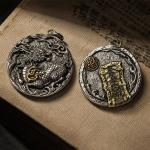
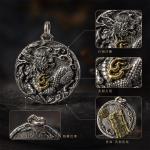
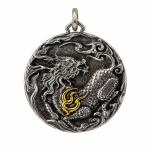
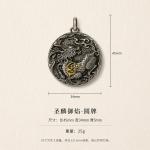
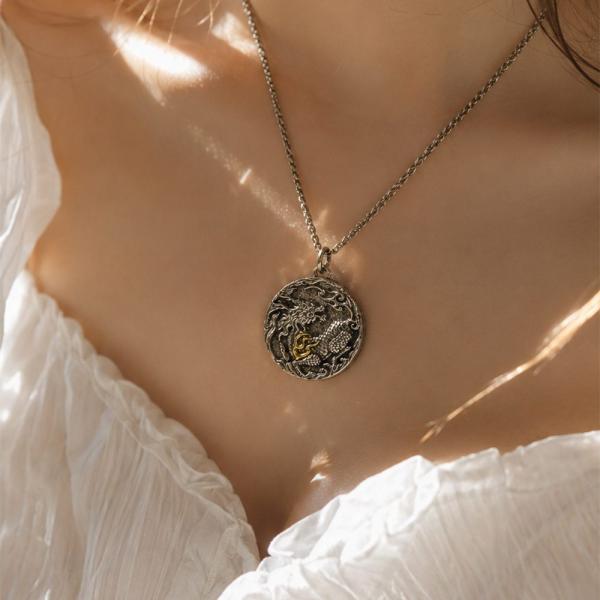
The qilin's horn sweeps back, and flame patterns run from the jaw to the foreleg. Scale overlaps scale; the carving is shallow at the edges of the plate and deep at the centre, so the layering only shows when light comes in at an angle. The plaque is not thick, and a fine ridge stands along the rim so it does not snag thread when worn outside a coat. The flames travel on the diagonal, lifting from lower left to upper right and tapering to points, set against the direction the qilin has turned its head, so the whole plaque's force twists into one place. No blank ground is left on the face; the body fills it, with only the four corners given a little air.
In the Book of Rites the qilin stands with the dragon, the phoenix and the turtle as the Four Spirits. Legend has it that its hooves never tread on living grass and it never breaks a growing branch, which makes it a beast of benevolence and ties it to the word for good fortune. Folk qilin are usually paired with books, with a ruyi sceptre, or with a child, from the tale of the qilin spitting out a jade book — a wish that the household would produce a scholar. This piece does not take that route. It is paired with flames, hot and a little fierce, and suits anyone who does not want to wear something too bookish. Most qilin made now ignore the Four Spirits rules; if it looks good and reads as a qilin, that passes.
White copper is the base, and the gold sits deeper in the recesses of the scales and flames and brighter on the raised parts. That difference is not an artificial patina; it comes from the angle of reflection across a curved surface, and it shows more on the piece itself than in a photograph. Pinch the body at the edge and shake it: it does not distort readily, which says the wall is not a thin sheet. The hanging loop at the back is joined into the body, so the load is carried properly and it does not loosen with long wear. The back is flat, comfortable against the chest, and nothing shows through a layer of clothing.
Gold tone suffers most from friction and sweat. Worn against skin in summer, the back will go dull within a month; that is the salt in sweat filming the surface. Rinse with clear water and blot with a soft cloth. Do not scrub at it with tissue — wood pulp in the paper raises a haze over time. The points of the flames like to catch knitwear, so tuck the pendant inside the collar when you wear a sweater. Lay it flat when it comes off, and do not let other pendants rest on top of it. On a piece with a thin surface colour, a fingernail leaves a white line.
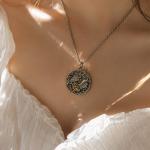
The two options differ in the fittings. The pendant alone is for anyone who already has a chain and likes to put their own leather cord or a plain chain on it. The necklace version ships with the chain already matched, wearable on arrival. Chain weight should suit the pendant: a fine chain under a heavy plaque lets it turn over, and turned over it shows its back to the room. With leather, choose dark brown or black, which does not fight the gold. Pick a small clasp for the cord so it passes through the loop without looking clumsy.