


Menu
By theme
By theme

{{ variable.name }} : {{ variable.values[selectedVariantsIndex[variable_index]].name }}
Quantity:
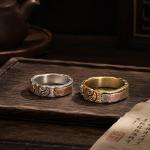
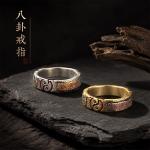
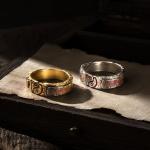
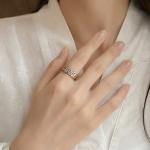
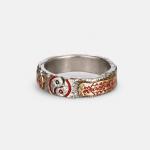
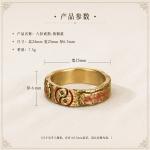
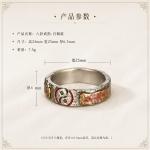
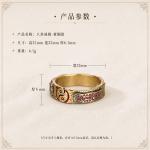
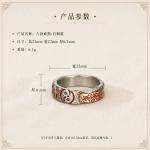
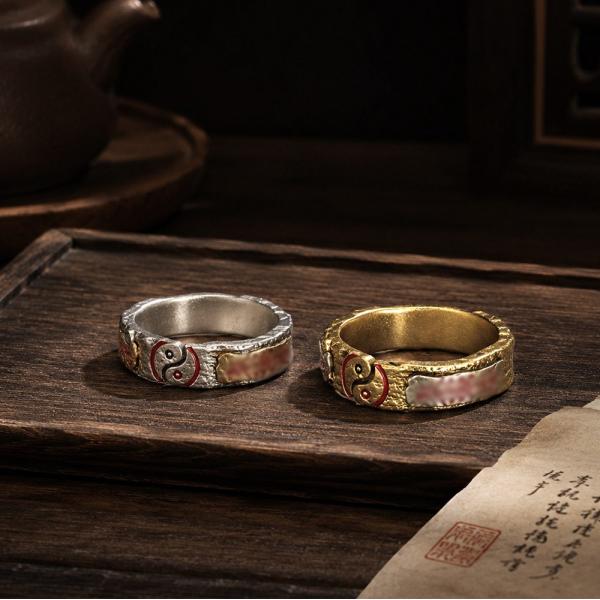
The bagua runs right round the band, the yao lines cut one by one: a yang line is whole, a yin line is broken in the middle. The eight trigrams join end to end with no blank ground between them, so turning the ring you see one continuous run of horizontal lines. The face is on the wide side, and men's and women's versions are made separately — width and band size are not the same measurement, so choose by the thickness of the finger rather than by sex. The inside is plain and polished; it does not slip when the hand is dry, and turns a little when it is not. The edge of the face takes a rounded chamfer, so it does not scrape the side of the finger and does not get in the way when you type.
The unit of the bagua is the yao: unbroken is yang, broken is yin, three stacked make a trigram, and eight ways of stacking give the eight. The Earlier Heaven and Later Heaven arrangements place them differently — the first is about opposition, the second about sequence. A ring mostly takes the sense of enclosure, and which set it follows varies with the draftsman; neither is wrong. Set against each other, qian and kun still stand north and south either way; the difference falls on the other six. A fine gap is left between trigrams, which marks them apart and keeps the whole ring from blurring into one band of lines.
Gold and silver are two surface colours on the same white copper base. Gold runs warm and suits skin with yellow in it; silver runs cool and suits pale skin and dark clothing. The surface colour wears fastest on a ring, especially on the inner face against the palm — a month will show it. That is common to rings rather than a fault of this one, and it goes faster on hands that work. The silver one drifts grey with long wear, the gold one drifts red; the two age differently.
The band is open and adjusts, so it will make do from slim to thick. When you adjust it, do not squeeze the raised lines of the bagua; the yao are fine and will collapse under pressure. Put your thumbs against the inside of the face and push outward evenly. Copper has a memory, so set it once and leave it; bend it back and forth and the two ends of the opening stop lining up, one high and one low. Once it is on, turn it a full circle and ease it out a touch wherever it feels tight. Start loose: a day on your feet swells the finger, and a tight ring will not come off at night.
Hand soap and hand cream stay on the inside of the band, and in time they build into a grey-white paste. Once a week, take it off and work it with warm water and a little soap, then dry it with a soft cloth before putting it back on. Do not use a silver-polishing cloth on the gold one; the chemicals in it will eat the surface colour. Do not wear it in the bath: hot water can raise bubbles and white patches in the finish, and once they are there the only fix is to polish it back, which is not worth it. Do not leave it on a windowsill either; long sun shifts the surface tone.