


Menu
By theme
By theme




{{ variable.name }} : {{ variable.values[selectedVariantsIndex[variable_index]].name }}
Quantity:
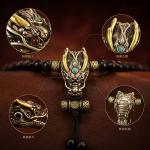
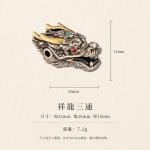
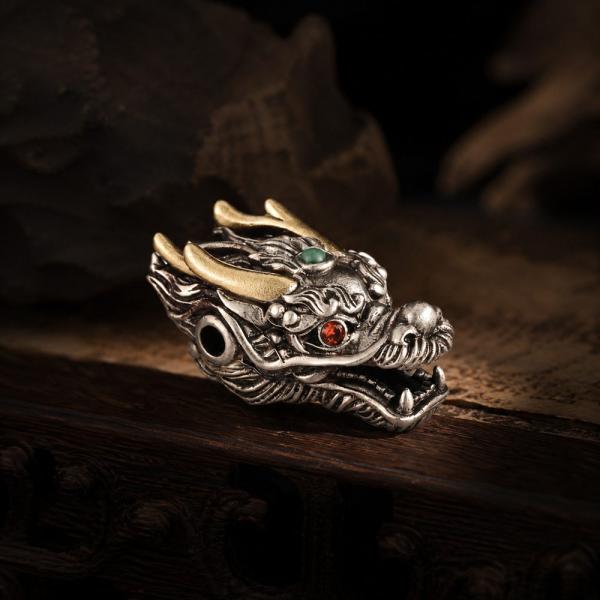
The dragon's body coils through a curve and the head comes out of it, the scales overlapping along the line of the body. After the antiquing the seams between scales go black and the body stands out in relief. There are horns on the head, laid back, and the whiskers are two fine lines falling from the jaw. The three holes open on the two sides of the body and at the top, tucked into the pattern so you will not find them unless you look. The tail comes back round against the flank, its tip cut with a few short strokes; without close looking it does not read as a tail at all.
A three-hole bead is the bead that closes a hand strand, one bead doing the work of three: the main line comes up through the bottom, branch beads attach at the sides, and the top takes a stupa bead or a direct knot. Shift the holes a little off centre and the whole strand sits crooked, so the drilling, not the carving, is what such a piece is judged on. The channels must be straight and the several holes must share an axis, or the cord binds as it passes. The inside of the mouths is polished and feels smooth. On a small piece the holes matter more than the carving: true holes and the strand hangs true. Dry-string it once before you commit, and only glue or knot when it sits right.
Dragon patterns appear early on objects — early enough that coiled dragon forms are found on Neolithic jade. Later dragons grew more elaborate, with set conventions for scale, claw and whisker; folk carving does not keep to the dynastic rules but to presence: head up, body arched. This dragon's neck is lifted, the eyes cut as two small pits that go black with the antiquing, and the look comes out of them. The scales are cut in overlapping layers, shallow at the edges and deep along the spine, so they only show when light comes in at an angle.
The white copper is antiqued: black in the hollows, bright on the raised parts. A freshly antiqued piece sheds a little surface colour at first; two wipes with a dry cloth settle it. Do not wash it straight away — what comes off is the antiqued layer, and the even copper underneath looks worse, and then the patina has to be started over. The black in the hollows is fixed and does not keep coming off; handled, it settles. Keep your hands clean while working it, since oily hands turn it dull. The antiqued layer dislikes alkali: soapy water turns it white, and a white patch will not blend with what is around it.
The dragon's body is thick, so it wants large beads; with fine ones it looks top-heavy. Use a dark cord — black or deep coffee will hold it; a red cord against antiqued copper also looks well, though it shows dirt and has to be changed often. Set the head facing outward so a lift of the wrist shows the face. If you thread the hole double, twist the ends tight first so loose fibres do not jam in the channel. When pairing with large beads, choose a three-hole bead a size larger than them; smaller and it will not close the strand.