


Menu
By theme
By theme




{{ variable.name }} : {{ variable.values[selectedVariantsIndex[variable_index]].name }}
Quantity:
The taiji diagram is commonly called the yin-yang fish: one black, one white, a dot of black in the white and a dot of white in the black. The figure settled later than the bagua, only taking its present form after the Song; earlier versions look quite different. The bagua is older and appears in the Yi; that Fu Xi drew the trigrams is legend, and whether it can be pinned down is another matter, but the lines themselves are very old and have been found on excavated objects. Both sequences of trigrams are used on plaques, and there is no need to fret over which at purchase. If it looks right on, that is enough.
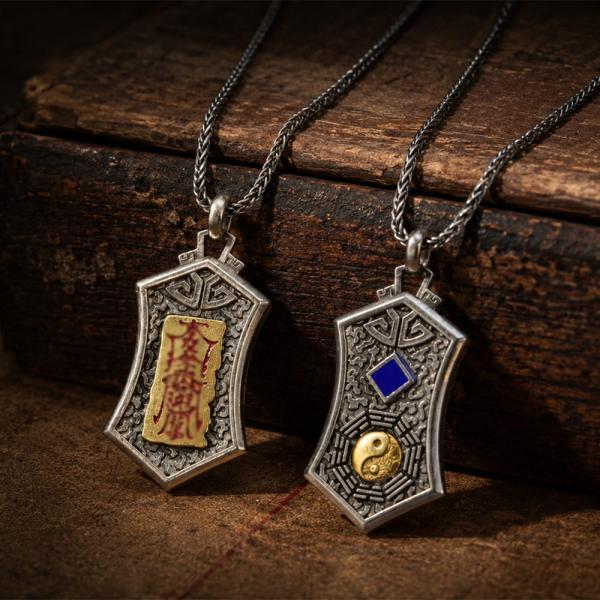
The taiji sits at the centre with the bagua in an outer ring. The two eyes of the taiji are cut as small round dots, a layer deeper than the ground around them. The yao run round in a circle, and whether qian is at the top or kun depends on the arrangement. The plaque is round, held by a narrow ridge at the rim that keeps the pattern off the edge. It is not thick overall, and the back is flat, with only the hanging point left at the upper middle. The line dividing the two fish is cut deeper than the bodies, so they look separate while the ground beneath is one piece. The rim is narrow, so knocks show.
Of the four options, the floating box is packaging: the pendant is suspended in the middle of the box, which makes a good gift. The sandalwood cord adjusts for length, is thick, and sits close to the neck. The flat-link chain is the usual match, its links flat so they do not catch hair. The fourth is listed as a Daoist amulet pendant, which pairs the pendant with an amulet; ask before ordering exactly what is included rather than guessing. The lid of the floating box is clear and presses shut, and once closed the pendant hangs in the middle without touching the sides.
The white copper face is made round with a narrow ridge at the rim. The taiji ring stands proud and the bagua ring is sunk; one raised, one hollow, and a finger drawn across can feel the difference in level. That difference does not show in a photograph; it is clearer in the hand. Polishing goes to the raised surfaces and the hollows are left slightly matte, so light falls bright and dark across it. Thickness is even and the edge does not scratch. The face is small and the pattern dense, so the polishing happens in the seams, and where the wheel cannot reach the matte stays.
Dust collects most in the sunken yao, above all in the break at the middle of a yin line. Do not pick at it with a needle; use a soft brush. White copper darkens with sweat, and the dark does not hinder reading it — it throws the yao lines up more clearly. If you want it bright, polish the raised surfaces and leave the hollows dark, which looks better. Take it off for washing: water sits in the dots of the yin-yang fish and dries as a pale ring. Keep it in its box when it comes off; stacked against another plaque, the rims knock chips out of each other.