


Menu
By theme
By theme




{{ variable.name }} : {{ variable.values[selectedVariantsIndex[variable_index]].name }}
Quantity:
The chi is a kind of dragon. The Shuowen says it is “like a dragon but yellow”, and others hold that a dragon without horns is a chi. Chi patterns were used heavily on jade and bronze from the Warring States through Qin and Han: the body coiled into an S, the four limbs braced out, the tail curled up, and that pose has held for two thousand years. Sword fittings, belt hooks and seal knobs carried it afterwards, and jade carvers still use the form. Han jade chi favour the “chi tiger”, squarer in the body; later versions soften and bend further. Two things identify a chi: no horns, and a curled tail. Get both and you are close enough.
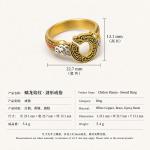
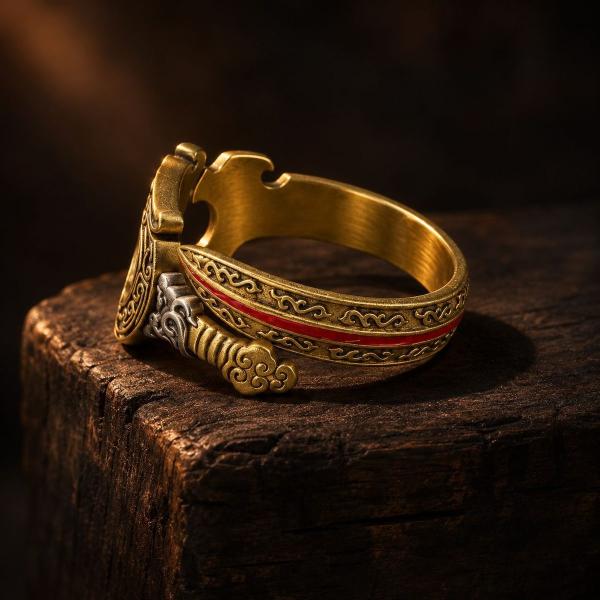
The chi has no horns; the body arches and flame patterns spread from the spine. The head lies at one side of the face and the tail comes round to the other, broken in between, so the opening of the band falls exactly where the tail would be. The body is long and slender, four feet braced on the face, the claws cut short so they do not prick. The flames overlap one over the next, spreading from the spine to either side, and they stop at the edge of the face without crossing it. The face is not wide; the body takes most of it, and the flames are left to keep the edges company.
The flames follow the dragon's body; they are not a pattern on their own. In cutting, each flame must overlap the tail of the one before, and where it does not, the line breaks. That depth is the work of a graver; stamped patterns are the same thickness in every stroke and look flat, while hand-cut ones have a place or two where the tool was pulled up sharply, and that is what makes them alive. The cutting on the face is not deep — a finger run across it finds a series of shallow ridges that do not catch cloth. The tip of each flame closes into a small curl, drawn tight, which is a finish only hand-cutting gives.
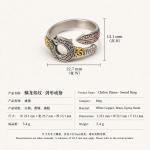
White and yellow are two colours: white is the natural tone of the white copper, yellow runs warm. The yellow one looks well with dark clothing; the white is colder and does not look hot in summer. Neither is silver, so do not go at it with a silver cloth — on the yellow one especially, the chemicals in the cloth will eat a patch of the surface colour and it cannot be put back. When the white one dulls, a dry cloth is enough. Natural white copper takes on warmth as it ages and wears better than the yellow. And no toothpaste on the yellow one; the abrasive in it will haze the surface colour.
The gap in an open band sits at the tail section. Bend it holding the two sides of the head, not the tips of the flames, which are thin and will roll if knocked against something hard, and a rolled tip does not come back. Wipe dull white copper with a dry cloth, and where that will not shift it, a little toothpaste. Rinse the yellow one afterwards; toothpaste left in the seams turns white in time. Keep hand cream off the inside of the band, since it makes the ring slippery and easy to drop. After washing your hands, take the ring off and dry it; water sits in the gap and in time turns green.