


Menu
By theme
By theme




{{ variable.name }} : {{ variable.values[selectedVariantsIndex[variable_index]].name }}
Quantity:
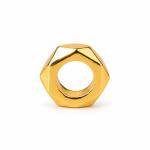
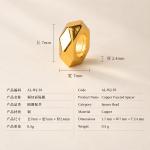
A hexagon, all six faces cut, so light jumps off it. The spacer ring has a hole through the middle, sits on the cord, and takes a bead on either side. The edges where the facets meet are straight, with the corners left slightly blunt so they do not cut the cord. The six faces are equal in width; turn it and the divisions are clear, with no face wider than the rest. Around the mouth of the hole is a very narrow flat, not a plain chamfer, and the cord runs against that flat instead of wearing on an edge.
A spacer is the least conspicuous thing on a strand; its job is to keep two beads from grinding each other. Wood against wood wears a ring into both in time; put a piece of metal between them and the metal takes the wear, and the beads are saved. So a spacer need not be handsome: the hole must be true, the edges flat, the thickness even. Too thin and it does not separate; too thick and the strand goes slack. A strand uses more of them than you would think — four or five on one bracelet is ordinary — so buy enough at once, or you will not match the colour. Take them from the same batch; facet angles differ a little between batches.
White copper, made thin, with almost no weight in the hand. Both faces of the hole are chamfered, so the cord does not scrape going through. The bore is a standard size and takes ordinary cord, with doubled elastic squeezing through as well. The six corners are dressed and are not sharp, so they do not press marks into the neighbouring beads. Facets stand up to scratches better than a polished face: a scratch on a flat does not show, and only one on an edge catches the eye.
A spacer hides among the beads and is the first thing forgotten. It oxidises too; the dark does not affect use, but it rubs against the beads beside it, and white copper oxide leaves grey marks on pale beads. Take the strand apart once every six months, wipe the spacers and string it again. Note the order as you take it apart; one bead out of place and the pattern is spoiled. The oxide is soft and does not damage the beads it touches, it only looks bad, and it should be wiped one way rather than rubbed back and forth.
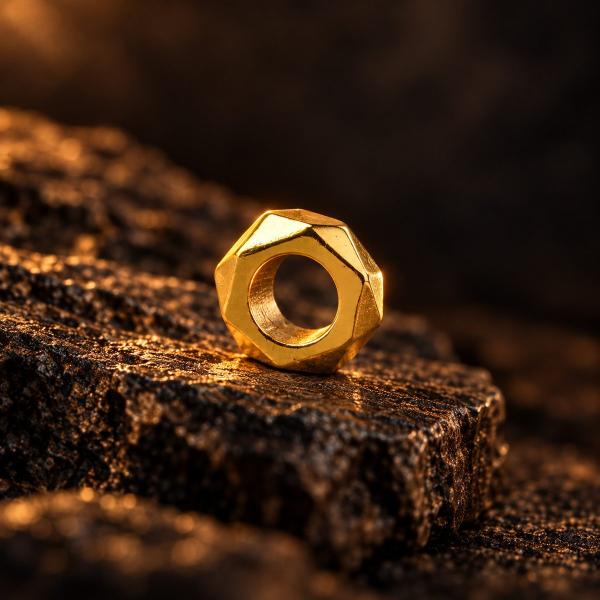
The point of facets is reflection. White metal cut into flats throws light at a different angle from each one, so a turn gives a flash, which is more interesting than a polished ring. Facets hold light as well, so no lamp is needed for a photograph; stand by a window and the highlights are there. The drawback is that dust lodges along the edges between faces, and you have to get a cloth corner into them. On a faceted piece the brightness changes with a slight turn: dark across the table, bright again at the window.